
2026 Tax Brackets Explained: What Every American Needs to Know
Tax season brings uncertainty for millions of Americans. Will you owe more this year? Are you withholding enough from your paycheck? Understanding the 2026 tax brackets can save you from costly surprises and help you keep more money in your pocket.
The federal tax system uses progressive tax brackets. This means different portions of your income get taxed at different rates. Many taxpayers misunderstand this concept and believe their entire income faces taxation at one rate.
This confusion leads to poor financial decisions. Some people turn down raises, thinking they will lose money. Others fail to adjust their withholding, resulting in unexpected tax bills when filing their returns.
The 2026 tax year brings important changes you need to understand. Inflation adjustments affect bracket thresholds. The Internal Revenue Service updates these amounts annually to prevent bracket creep, where inflation pushes taxpayers into higher tax brackets without increasing their real purchasing power.
Calculate Your 2026 Tax Bracket
See exactly how much you’ll owe with our free tax estimator. Get personalized insights based on your income, filing status, and deductions in under 2 minutes.
What Tax Brackets Mean: Understanding the Basics
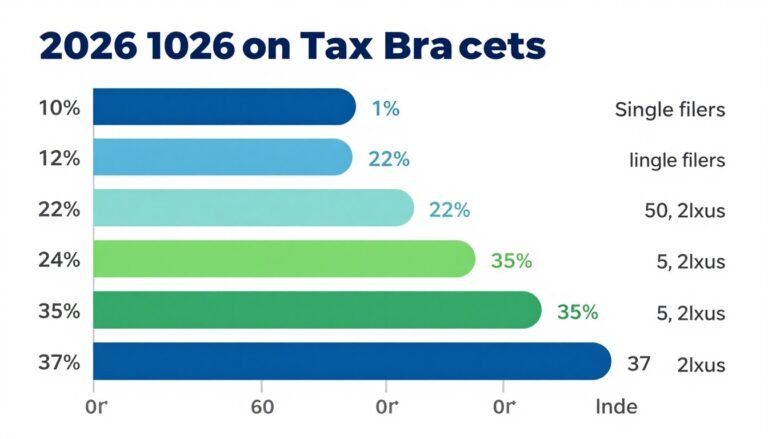
Tax brackets determine how much federal income tax you pay on different portions of your income. The United States uses a progressive tax system with seven tax bracket rates for the 2026 tax year.
Your marginal tax rate represents the tax rate applied to your last dollar of income. Your effective tax rate shows the average rate you pay across all your income. These two rates differ significantly for most taxpayers.
Key Tax Terms You Should Know
Several important terms affect how you calculate your tax liability. Understanding these concepts helps you make better financial decisions throughout the year.
Taxable Income
Your taxable income equals your gross income minus deductions and exemptions. This amount determines which tax brackets apply to your situation.
- Includes wages, salaries, and tips
- Covers investment income and capital gains
- Reduced by standard or itemized deductions
- Different from your gross income
Marginal Tax Rate
The marginal rate applies only to your next dollar of income. It represents your highest tax bracket, not the rate on your entire income.
- Affects decisions about additional income
- Used for calculating deduction value
- Changes when you cross bracket thresholds
- Higher than your effective tax rate
Effective Tax Rate
Your effective rate shows the actual percentage of your income paid in taxes. It provides a better picture of your overall tax burden.
- Always lower than marginal rate
- Calculated by dividing tax by income
- Useful for comparing tax situations
- Reflects your true tax burden
Filing Status
Your filing status determines which bracket thresholds apply to you. Different statuses have different income ranges for each tax rate.
- Single filers have lower thresholds
- Married filing jointly doubles most brackets
- Head of household falls between
- Can change year to year
How Progressive Taxation Works
The progressive tax system taxes income in layers. Think of it like filling containers of different sizes, where each container has its own price per gallon.
Your first dollars of income fill the lowest tax bracket at the lowest rate. Once that bracket fills completely, additional income moves to the next bracket at a higher rate. This continues through each bracket until all your income is accounted for.
This structure means you never lose money by earning more. Higher income always results in more after-tax money, even when you enter a higher tax bracket. Only the amount above the threshold gets taxed at the higher rate.
Consider a single filer earning $50,000 in taxable income. The first portion gets taxed at 10%, the next portion at 12%, and the remaining amount at 22%. The entire $50,000 does not face the 22% rate.
2026 Federal Tax Brackets and Rates
The Internal Revenue Service adjusts tax brackets annually for inflation. These adjustments prevent taxpayers from facing higher effective rates simply because their income keeps pace with rising prices.
For the 2026 tax year, seven tax bracket rates apply to ordinary income. These rates remain unchanged from previous years, but the income thresholds increase to reflect inflation adjustments.
Tax Brackets for Single Filers in 2026
Single taxpayers face different bracket thresholds compared to other filing statuses. These amounts apply to your taxable income after subtracting your standard deduction.
| Tax Rate | Income Range | Tax on Base Amount |
| 10% | $0 to $11,925 | $0 |
| 12% | $11,926 to $48,475 | $1,193 |
| 22% | $48,476 to $103,350 | $5,579 |
| 24% | $103,351 to $197,300 | $17,651 |
| 32% | $197,301 to $250,525 | $40,199 |
| 35% | $250,526 to $626,350 | $57,231 |
| 37% | $626,351 and above | $188,770 |
Tax Brackets for Married Filing Jointly in 2026
Married couples filing jointly benefit from bracket thresholds that roughly double those for single filers. This structure reduces the marriage penalty that affected previous tax systems.
| Tax Rate | Income Range | Tax on Base Amount |
| 10% | $0 to $23,850 | $0 |
| 12% | $23,851 to $96,950 | $2,385 |
| 22% | $96,951 to $206,700 | $11,157 |
| 24% | $206,701 to $394,600 | $35,302 |
| 32% | $394,601 to $501,050 | $80,398 |
| 35% | $501,051 to $751,600 | $114,462 |
| 37% | $751,601 and above | $202,155 |
Tax Brackets for Married Filing Separately
Married taxpayers who file separately use different bracket thresholds. This filing status typically results in higher taxes compared to filing jointly, but some situations make it beneficial.
| Tax Rate | Income Range |
| 10% | $0 to $11,925 |
| 12% | $11,926 to $48,475 |
| 22% | $48,476 to $103,350 |
| 24% | $103,351 to $197,300 |
| 32% | $197,301 to $250,525 |
| 35% | $250,526 to $375,800 |
| 37% | $375,801 and above |
Tax Brackets for Head of Household
Head of household status provides more favorable bracket thresholds than single filing status. You qualify if you pay more than half the costs of maintaining a home for yourself and a qualifying dependent.
| Tax Rate | Income Range |
| 10% | $0 to $17,000 |
| 12% | $17,001 to $64,850 |
| 22% | $64,851 to $103,350 |
| 24% | $103,351 to $197,300 |
| 32% | $197,301 to $250,500 |
| 35% | $250,501 to $626,350 |
| 37% | $626,351 and above |
Standard Deduction Amounts for 2026
The standard deduction reduces your taxable income before applying tax brackets. Most taxpayers claim the standard deduction because it exceeds their potential itemized deductions.
For the 2026 tax year, standard deduction amounts increase to account for inflation. These amounts directly reduce the income subject to federal tax rates.
- Single filers: $15,000 standard deduction
- Married filing jointly: $30,000 standard deduction
- Married filing separately: $15,000 standard deduction
- Head of household: $22,500 standard deduction
- Additional amount for taxpayers over 65: $1,550 (single) or $1,250 (married)
- Additional amount for blind taxpayers: Same as age 65+ amounts
Who Is Most Affected by 2026 Tax Bracket Changes
Tax bracket adjustments affect different taxpayers in various ways. Understanding how these changes impact your specific situation helps you plan more effectively throughout the year.
Impact on Individual Wage Earners
Individual employees with steady income see predictable effects from bracket adjustments. Your paycheck withholding may need updating to reflect new thresholds.
Workers who received raises during 2025 might move into higher tax brackets in 2026. However, the inflation adjustments to bracket thresholds may offset some or all of this bracket creep.
Self-employed individuals face additional complexity. They pay both the employee and employer portions of Social Security and Medicare taxes. Their effective tax rate differs significantly from wage earners in the same tax bracket.
- Salary increases may push you into next bracket
- Bonus income can temporarily increase marginal rate
- Side income adds complexity to tax situation
- Withholding adjustments prevent year-end surprises
Effects on Families with Children
Family situations create unique tax considerations. Filing status, dependent credits, and childcare expenses all interact with tax brackets to determine your final tax liability.
Married couples filing jointly benefit from doubled bracket thresholds. Single parents who qualify as head of household receive more favorable brackets than single filers without dependents.
The child tax credit provides $2,000 per qualifying child, directly reducing your tax bill. This credit phases out at higher income levels, effectively increasing your marginal tax rate when the phaseout applies.
- Child tax credit reduces overall tax burden
- Dependent care credit helps working parents
- Education credits offset college costs
- Head of household status lowers tax liability
- Filing status changes after marriage or divorce
Small Business Owners and Tax Planning
Business owners have more tools to manage their tax bracket position. Business deductions, retirement contributions, and income timing strategies provide flexibility unavailable to wage earners.
The qualified business income deduction allows many business owners to deduct up to 20% of their business income. This deduction effectively reduces your taxable income before applying bracket rates.

Business owners can time income and expenses to optimize their tax bracket position. Deferring income to the following year or accelerating deductions into the current year can reduce tax liability when done strategically.
- Qualified business income deduction reduces taxable income
- Retirement plan contributions lower current taxes
- Equipment purchases provide immediate deductions
- Income timing affects bracket positioning
- Estimated tax payments require careful planning
- S-corporation structure may reduce self-employment tax
Investors and Capital Gains Considerations
Investment income faces different tax treatment than ordinary income. Long-term capital gains and qualified dividends benefit from preferential tax rates separate from the standard bracket structure.
Your ordinary income tax bracket determines your capital gains rate. Taxpayers in the 10% or 12% brackets pay 0% on long-term gains. Those in brackets up to 37% pay 15% on gains. The highest earners pay 20% on capital gains.
Interest income from bonds and savings accounts faces taxation at ordinary income rates. This makes the tax treatment less favorable than qualified dividends or long-term capital gains.
- Long-term capital gains receive preferential rates
- Short-term gains taxed as ordinary income
- Dividend income often qualifies for lower rates
- Tax-loss harvesting can offset gains
- Municipal bond interest generally tax-exempt
- Retirement account withdrawals taxed as ordinary income
Common Tax Bracket Mistakes to Avoid
Taxpayers make predictable errors when dealing with tax brackets. Understanding these mistakes helps you avoid costly miscalculations and missed opportunities.
Confusing Marginal and Effective Tax Rates
The most common mistake involves misunderstanding how tax brackets work. Many people believe their entire income gets taxed at their highest bracket rate.
Your marginal tax rate applies only to income within that specific bracket. Income in lower brackets still gets taxed at lower rates. This means your effective tax rate stays well below your marginal rate.
Consider someone in the 24% bracket. Their effective rate might only be 16% because the first portions of their income faced 10%, 12%, and 22% rates. Only the income above the 24% threshold gets taxed at that rate.
Reality Check: Moving into a higher tax bracket never results in less take-home pay. Only the income above the bracket threshold gets taxed at the higher rate. Every additional dollar earned always increases your after-tax income.
Refusing Income to Avoid Higher Brackets
Some taxpayers decline raises, bonuses, or overtime because they fear moving into a higher bracket will reduce their take-home pay. This mistake costs them significant income based on a misunderstanding.
The progressive tax system ensures you always benefit from additional income. Even if a raise pushes you into the next bracket, only the amount above the threshold faces the higher rate.
Example: A single filer earning $48,000 who gets a $5,000 raise will see some income taxed at 22% instead of 12%. However, they still keep 78% of that additional $5,000, significantly increasing their take-home pay.
Ignoring Withholding Adjustments
Life changes affect your tax situation, but many taxpayers never update their W-4 withholding forms. This leads to owing taxes at filing time or receiving unnecessarily large refunds.
Marriage, divorce, having children, or significant income changes all warrant withholding adjustments. The IRS provides a withholding calculator to help determine the correct amount for your situation.
Large tax refunds mean you gave the government an interest-free loan throughout the year. Adjusting withholding puts that money in your pocket each paycheck instead of waiting for a refund.
- Update W-4 after major life changes
- Review withholding when income increases
- Adjust for second jobs or spouse income
- Consider side income when setting withholding
- Use IRS withholding calculator annually
Filing Under the Wrong Status
Filing status significantly affects your tax brackets and standard deduction. Some taxpayers automatically choose single or married without considering whether head of household status might apply.
Head of household provides better tax brackets than single status and a higher standard deduction. You qualify if you’re unmarried, pay more than half the household costs, and have a qualifying dependent living with you for more than half the year.
Married couples sometimes benefit from filing separately, though this is uncommon. Situations involving student loan repayment plans or medical expense deductions might make separate filing advantageous despite higher tax rates.
Missing Bracket Optimization Opportunities
Many taxpayers fail to use strategies that could keep them in lower brackets or maximize the value of deductions. These missed opportunities cost money every year.
Traditional IRA and 401(k) contributions reduce your taxable income, potentially keeping you in a lower bracket. Health savings account contributions provide similar benefits while building tax-free medical savings.
Bunching itemized deductions into alternate years can exceed the standard deduction, providing larger tax savings. This strategy works well for charitable contributions and medical expenses you can control the timing of.
- Maximize retirement contributions before year-end
- Consider bunching deductions in alternate years
- Time capital gains and losses strategically
- Explore health savings account contributions
- Review opportunity for income deferral
Overlooking State Tax Implications
Federal tax brackets represent only part of your tax burden. State income taxes add another layer that varies significantly by location.
Some states have no income tax, while others impose rates exceeding 13%. A few states use flat tax rates, while most employ progressive bracket systems similar to federal taxes.
Your combined federal and state marginal rate determines the true value of deductions and the cost of additional income. High-income residents of high-tax states can face combined marginal rates exceeding 50%.
Legal Strategies to Reduce Your Tax Bracket Impact
Smart tax planning helps minimize your tax liability without crossing legal boundaries. These strategies work within the tax code to reduce how much you owe.
Maximize Retirement Account Contributions
Contributions to traditional retirement accounts reduce your current taxable income. The money grows tax-deferred until withdrawal, and you might be in a lower tax bracket during retirement.
For 2026, 401(k) contribution limits allow you to defer substantial income. Contributing the maximum amount can drop you into a lower tax bracket while building retirement savings.
Traditional IRA contributions also reduce taxable income if you meet income requirements. Even if you have a workplace retirement plan, you might qualify for deductible IRA contributions depending on your income level.
- 401(k) contributions reduce taxable income dollar-for-dollar
- Traditional IRA contributions provide deduction if eligible
- Catch-up contributions available after age 50
- Employer match represents free money
- Consider Roth options for tax-free growth
- Self-employed can use SEP or Solo 401(k) plans
Leverage Health Savings Accounts
Health savings accounts provide triple tax benefits unavailable in other savings vehicles. Contributions reduce taxable income, earnings grow tax-free, and withdrawals for medical expenses face no taxation.
You must have a high-deductible health plan to qualify for an HSA. Once eligible, maximize contributions to reduce your current tax bracket while building medical savings for the future.
HSA funds roll over year after year, unlike flexible spending accounts. This makes them excellent vehicles for long-term medical savings and even retirement planning.
HSA Strategy: Many financial experts recommend paying current medical expenses out of pocket when possible and letting HSA funds grow tax-free. After age 65, you can withdraw HSA money for any purpose, paying only ordinary income tax like a traditional IRA.
Strategic Charitable Giving
Charitable contributions provide tax deductions when you itemize. Strategic giving approaches can maximize the tax benefit while supporting causes you care about.
Bunching charitable contributions into a single year can push your itemized deductions above the standard deduction threshold. You donate two years’ worth of planned giving in one year, then claim the standard deduction the following year.
Donor-advised funds facilitate this strategy. You contribute to the fund in one tax year, receiving an immediate deduction. Then you recommend grants to charities over multiple years from the fund.
Donating appreciated stock provides additional benefits. You avoid capital gains tax on the appreciation and deduct the full current market value, assuming you held the stock for more than one year.
Optimize Investment Tax Treatment
Where you hold investments affects your tax liability. Tax-advantaged accounts should hold investments that generate significant taxable income, while taxable accounts work better for tax-efficient investments.
Municipal bonds generate tax-exempt interest at the federal level, and often at state level for residents. While yields run lower than taxable bonds, the after-tax return often exceeds taxable alternatives for those in higher brackets.
Tax-loss harvesting allows you to sell losing investments to offset capital gains. You can deduct up to $3,000 of excess losses against ordinary income each year, with remaining losses carried forward.
- Hold high-yield bonds in retirement accounts
- Keep stock index funds in taxable accounts
- Consider municipal bonds for taxable accounts
- Harvest losses to offset gains strategically
- Time capital gains realization carefully
- Hold investments over one year for lower rates
Business Expense Deductions
Self-employed individuals and business owners can deduct ordinary and necessary business expenses. Proper documentation and legitimate business purpose make these deductions defensible.
Home office deductions reduce taxable income for those who work from home. You must use the space regularly and exclusively for business to qualify for this deduction.
Vehicle expenses for business use provide substantial deductions. You can choose between actual expenses or the standard mileage rate, whichever provides the larger deduction.
Education expenses related to maintaining or improving skills for your current business qualify as deductible expenses. This includes courses, seminars, and professional certifications.
Timing Income and Deductions
When you realize income and claim deductions affects which tax year they impact. Strategic timing can reduce your tax bracket in high-income years.
Deferring year-end income to early January pushes that income into the following tax year. This strategy works well if you expect to be in a lower bracket next year or simply want to delay the tax payment.
Accelerating deductions into the current year provides immediate tax benefits. Paying January’s mortgage payment in December or making quarterly estimated state tax payments early can increase current-year deductions.
Business owners have more flexibility in timing. They can delay invoicing clients until January or accelerate purchases of business equipment into December to optimize their tax situation.
Real Tax Calculation Example: Sarah’s 2026 Tax Situation
Walking through a real example demonstrates how tax brackets actually work. Let’s examine Sarah’s tax situation to see how progressive taxation applies in practice.
Sarah’s Financial Profile
Sarah works as a marketing manager earning $75,000 annually. She’s single with no dependents and claims the standard deduction. Her employer withholds taxes from each paycheck based on her W-4 elections.
She also earned $2,000 in interest from her savings account and $3,000 from freelance consulting work. Her total gross income for 2026 reaches $80,000.
Calculating Sarah’s Taxable Income
Sarah’s taxable income calculation starts with her gross income and subtracts eligible deductions. As a single filer taking the standard deduction, her calculation looks like this:
- Total gross income: $80,000
- Standard deduction for single filers: -$15,000
- Taxable income: $65,000
The $65,000 taxable income amount determines which brackets apply to calculate her federal income tax liability.
Applying Tax Brackets to Calculate Tax Owed
Sarah’s $65,000 taxable income spans three different tax brackets. Each portion gets taxed at its corresponding rate:
Bracket-by-Bracket Calculation
- First $11,925 taxed at 10% = $1,193
- Next $36,550 ($48,475 – $11,925) taxed at 12% = $4,386
- Remaining $16,525 ($65,000 – $48,475) taxed at 22% = $3,636
Total federal income tax: $9,215
Key Tax Metrics
- Marginal tax rate: 22%
- Effective tax rate: 14.2%
- Tax as % of gross: 11.5%
- Take-home after federal tax: $70,785
Understanding Sarah’s Tax Rates
Sarah’s situation illustrates the difference between marginal and effective tax rates. While she falls in the 22% tax bracket, her effective rate of 14.2% shows the actual percentage of her taxable income paid in federal taxes.
If Sarah receives a $5,000 raise, only the additional amount above $48,475 gets taxed at 22%. The portion up to that threshold still benefits from the lower 10% and 12% rates.
Her freelance income requires additional considerations. Self-employment tax applies to the $3,000 consulting income at 15.3%, adding approximately $459 to her total tax liability. She can deduct half of this self-employment tax as an adjustment to income.
How Different Scenarios Would Change Sarah’s Taxes
Various financial decisions would affect Sarah’s tax situation. Understanding these impacts helps with tax planning throughout the year.
- Contributing $6,000 to traditional IRA saves $1,320 in taxes
- Maxing out 401(k) at $23,000 saves $5,060 in taxes
- Opening HSA and contributing $4,300 saves $946 in taxes
- Making $3,000 in charitable donations saves $660 if itemizing
Tax-Reducing Moves
- Taking $10,000 from traditional IRA adds $2,200 in taxes
- Selling stocks with $5,000 short-term gain adds $1,100 in taxes
- Bonus of $15,000 adds $3,300 in federal taxes
- Additional freelance income of $10,000 adds $2,200 plus self-employment tax
Tax-Increasing Events
Future Tax Changes and Trends to Watch
The tax landscape constantly evolves through legislation, economic factors, and policy changes. Understanding upcoming changes helps you plan effectively for future tax years.
Scheduled Changes Under Current Law
Several provisions of the Tax Cuts and Jobs Act expire after 2025. Unless Congress acts, significant changes will affect 2026 tax brackets and deductions.
The standard deduction may decrease significantly when provisions expire. Individual tax bracket rates could increase across most income levels. The estate tax exemption amount would drop substantially, affecting wealthy families.
These scheduled changes create uncertainty for long-term tax planning. Political changes and economic conditions will determine whether Congress extends current provisions, allows them to expire, or implements new tax legislation.
- Higher tax rates may return after TCJA provisions expire
- Standard deduction could decrease substantially
- Personal exemptions might return
- State and local tax deduction cap may change
- Pass-through business deduction future remains uncertain
Proposed Legislative Changes
Various tax proposals circulate in Congress that could affect future tax brackets. While predicting which proposals become law proves difficult, understanding the options helps with planning.
Some proposals would add new high-income tax brackets above the current 37% top rate. Others would change how capital gains get taxed, potentially eliminating preferential rates for high earners.
Retirement account contribution limits and rules face ongoing discussion. Some proposals would restrict Roth conversion strategies or change required minimum distribution rules.
Inflation and Bracket Adjustments
Annual inflation adjustments to tax brackets continue based on the chained Consumer Price Index. Higher inflation results in larger bracket increases, while low inflation produces smaller adjustments.
Economic conditions affect inflation rates unpredictably. Recent years saw higher-than-normal inflation, leading to larger bracket adjustments. Future inflation rates will determine how much brackets increase in subsequent years.
These automatic adjustments prevent bracket creep but don’t account for all economic factors. Real wage growth that exceeds inflation can still push taxpayers into higher brackets even with annual adjustments.
State Tax Trends
State tax policies evolve independently of federal changes. Some states have eliminated or reduced income taxes, while others increased rates or changed bracket structures.
Several states moved from progressive bracket systems to flat tax rates. Others expanded or contracted their tax bases by changing what income gets taxed or what deductions are allowed.
State tax considerations grow more important for mobile workers and retirees. The rise of remote work allows more taxpayers to choose their state of residence based partly on tax considerations.
- Remote work increases interstate tax complexity
- Several states eliminated or reduced income taxes
- High-tax states face resident migration
- Reciprocity agreements affect border workers
- State conformity to federal tax law varies
Technology and Tax Administration
The Internal Revenue Service continues modernizing its systems and processes. Increased automation affects how returns get processed and how audits get conducted.
Advanced data matching helps the IRS identify discrepancies more quickly. Third-party reporting from employers, financial institutions, and payment processors provides the IRS with extensive income information before you file.
Future changes may include pre-filled tax returns based on information already reported to the IRS. Some countries use this system successfully, though implementation in the US faces political and practical challenges.
Planning for Uncertainty
Tax planning becomes more challenging when future rules remain uncertain. Flexible strategies that work under multiple scenarios provide the best approach.
Diversifying between traditional and Roth retirement accounts hedges against future tax rate changes. If rates increase, Roth accounts provide tax-free withdrawals. If rates decrease, traditional account benefits prove more valuable.
Maintaining emergency funds and avoiding excessive tax-deferred account balances provides flexibility to respond to tax law changes. Required minimum distributions force taxable withdrawals regardless of your preferred timing.
Key Takeaways About 2026 Tax Brackets
Understanding tax brackets empowers you to make smarter financial decisions throughout the year. The progressive tax system means higher earnings always result in more take-home pay, despite fears about bracket creep.
Your marginal tax rate differs significantly from your effective rate. Only income above each threshold gets taxed at the higher bracket rate. This structure means entering a new bracket never reduces your overall income.
Planning opportunities exist at every income level. Retirement contributions, health savings accounts, and strategic deduction timing all help manage your tax bracket position. Small business owners and investors have additional tools for tax optimization.
State taxes add another layer beyond federal brackets. Your combined federal and state marginal rate determines the true cost of additional income and the value of deductions. High earners in high-tax states face substantially different economics than those in no-tax states.
Future tax law changes create uncertainty for long-term planning. The scheduled expiration of Tax Cuts and Jobs Act provisions may significantly alter the tax landscape. Flexible strategies that work under various scenarios provide the best protection against legislative changes.
Regular review of your tax situation helps prevent surprises. Life changes like marriage, children, job changes, or investment gains all affect your tax bracket and withholding needs. Annual checkups ensure your withholding matches your actual tax liability.
The 2026 tax year offers time to implement these strategies before year-end. Starting tax planning early provides maximum flexibility for timing decisions and capturing deductions. Waiting until December limits your options significantly.
Professional guidance becomes valuable when situations grow complex. Multiple income sources, business ownership, investment portfolios, and estate planning all benefit from expert analysis. The cost of professional advice often pays for itself through identified opportunities and avoided mistakes.
Take action now to understand your specific situation. Use available calculators and tools to estimate your tax bracket and liability. Review your withholding to prevent owing taxes or giving the government an interest-free loan. Consider the strategies discussed to optimize your position within the bracket structure.
Your financial success depends partly on managing tax efficiency. Understanding 2026 tax brackets provides the foundation for effective planning throughout the year and into future tax seasons.