Capital Gains Tax Explained: How Investors Can Pay Less
Investment profits feel great until tax season arrives. Many investors discover they owe thousands more in capital gains taxes than expected. This surprise can erase a significant portion of your investment returns.
Understanding how capital gains tax works isn’t optional anymore. With updated IRS rules for 2024-2025, knowing the difference between short-term and long-term capital gains can save you substantial money.
This guide explains everything about capital gains tax in plain language. You’ll learn current tax rates, legal strategies to reduce your tax burden, and common mistakes that cost investors money every year.
What Capital Gains Tax Means
Capital gains tax is the federal tax you pay on profits from selling investments. When you sell stocks, bonds, real estate, or other capital assets for more than you paid, the IRS considers that profit a capital gain.
The tax applies only to realized gains. Simply owning an investment that increases in value doesn’t trigger taxes. You must actually sell the asset to owe capital gains tax.
Key Terms You Need to Know
Several important terms define how capital gains taxes work:
- Cost Basis – The original purchase price of your investment plus any fees or commissions
- Capital Gain – The profit when you sell an asset for more than your cost basis
- Holding Period – How long you owned the investment before selling
- Realized Gain – The actual profit from a completed sale
- Net Capital Gains – Total gains minus any capital losses for the tax year
Simple Example of Capital Gains
Imagine you bought 100 shares of stock at $50 per share. Your total investment was $5,000. Two years later, you sell those shares at $80 each for $8,000 total.
Your capital gain equals the sale price minus the purchase price. That’s $8,000 minus $5,000, giving you a $3,000 capital gain. The IRS will tax this $3,000 profit according to capital gains tax rates.
Not all investment sales result in gains. If you sold those shares for $4,000 instead, you’d have a $1,000 capital loss. Capital losses can offset capital gains and reduce your tax burden.
Calculate Your Capital Gains Tax
Use our free capital gains tax calculator to estimate your tax liability before you sell. Get accurate projections based on current IRS rates for 2024-2025.
Current Tax Rules for 2024-2025
The IRS treats capital gains differently based on how long you held the investment. This distinction significantly impacts how much tax you’ll pay on investment profits.
Short-Term vs Long-Term Capital Gains
Short-term capital gains apply to investments held for one year or less. These gains are taxed as ordinary income at your regular income tax rate. Depending on your tax bracket, you could pay between 10% and 37% on short-term capital gains.
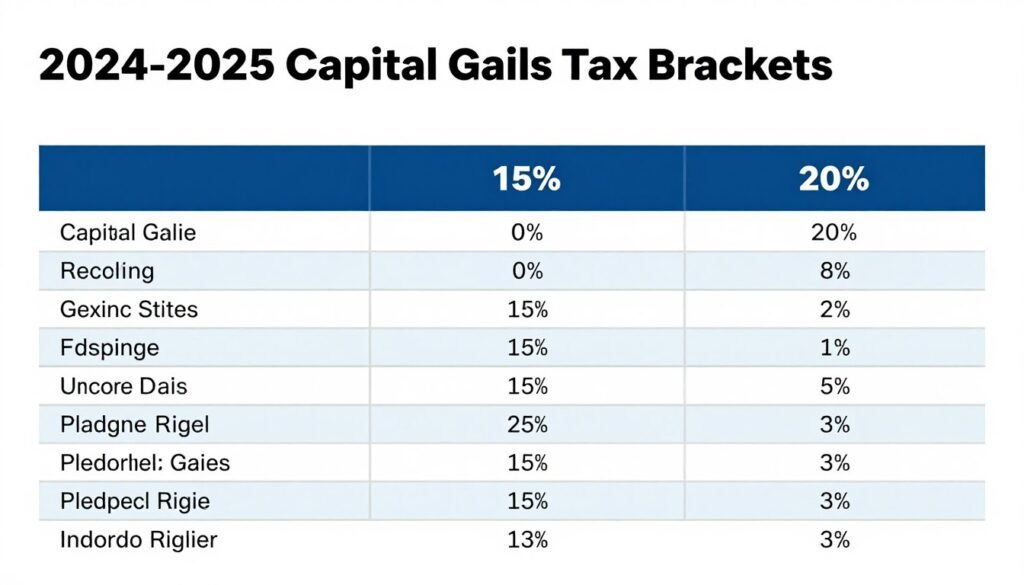
Long-term capital gains apply to investments held longer than one year. These receive preferential tax treatment with lower rates of 0%, 15%, or 20% based on your taxable income.
2024-2025 Long-Term Capital Gains Tax Rates
| Tax Rate | Single Filers | Married Filing Jointly | Head of Household |
| 0% | Up to $44,625 | Up to $89,250 | Up to $59,750 |
| 15% | $44,626 to $492,300 | $89,251 to $553,850 | $59,751 to $523,050 |
| 20% | Over $492,300 | Over $553,850 | Over $523,050 |
Additional Net Investment Income Tax
High-income taxpayers face an additional 3.8% net investment income tax. This Medicare surtax applies when your modified adjusted gross income exceeds certain thresholds.
The 3.8% tax kicks in at $200,000 for single filers and $250,000 for jointly married filing couples. This additional tax applies on top of regular capital gains tax rates, bringing the maximum effective rate to 23.8% for long-term gains.
Short-Term Capital Gains and Ordinary Income
Short-term capital gains follow ordinary income tax brackets for 2024-2025. These rates range from 10% to 37% depending on your total taxable income.
Most taxpayers pay between 22% and 24% on short-term capital gains. High earners can face rates as high as 37%, making the holding period extremely important for tax planning.
Who Is Most Affected by Capital Gains Tax

Capital gains taxes impact various types of taxpayers differently. Understanding how the tax affects your specific situation helps you plan more effectively.
Individual Stock Market Investors
Active traders and long-term investors both face capital gains taxes. Day traders often pay higher rates because their gains are taxed as ordinary income rather than at preferential capital gains tax rates.
Passive investors who buy and hold stocks typically benefit from long-term capital gains rates. They can strategically time sales to stay within lower tax brackets.
Real Estate Sellers
Homeowners and real estate investors encounter capital gains when selling property. Primary residence sales receive special treatment with exclusions up to $250,000 for single filers and $500,000 for married filing jointly couples.
Investment property sales are subject to capital gains tax on the full profit. Real estate investors must also consider depreciation recapture rules that can increase their tax liability.
Small Business Owners
Business owners selling their companies face significant capital gains tax implications. The sale of a business often represents years of accumulated value taxed in a single year.
Some business sales qualify for preferential treatment under qualified small business stock rules. These provisions can exclude up to 100% of capital gains under specific conditions.
Mutual Fund and ETF Holders
Fund investors may owe capital gains taxes even without selling shares. Mutual funds distribute capital gains to shareholders annually based on the fund manager’s trading activity.
These distributions are considered capital gains for tax purposes. You’ll receive a 1099-DIV form showing your share of the fund’s capital gains distribution.
Common Mistakes to Avoid with Capital Gains Tax
Many investors make preventable errors that increase their capital gains tax burden. Avoiding these mistakes can save thousands of dollars annually.
Failing to Report All Capital Gains
Every sale of stocks, bonds, or other investments must be reported to the IRS. Brokerages send Form 1099-B documenting your transactions, and the IRS receives copies too.
Missing even small gains from your tax return triggers IRS notices. The penalties and interest for unreported gains far exceed the original tax owed.
Confusing Short-Term and Long-Term Rates
Selling investments a few days before the one-year mark can be costly. The difference between ordinary income rates and capital gains tax rates often exceeds 15-20 percentage points.
Track your purchase dates carefully. Waiting just one day longer can dramatically reduce your tax bill on profitable investments.
Not Tracking Cost Basis Correctly
Your cost basis determines how much profit you made on an investment sale. Many investors use the wrong basis calculation, paying tax on phantom gains that don’t exist.
Reinvested dividends increase your cost basis. Stock splits affect your per-share basis. Keep detailed records of all transactions affecting your investment’s cost basis.
Missing the Net Investment Income Tax
High earners sometimes forget about the additional 3.8% tax on investment income. This Medicare surtax catches many taxpayers by surprise at filing time.
Plan for this extra tax if your income exceeds the thresholds. The 3.8% tax applies to your net investment income or the amount by which your modified adjusted gross income exceeds the threshold, whichever is less.
Ignoring State Capital Gains Taxes
Most states tax capital gains as regular income. Some states like California have high income tax rates that significantly increase your total tax burden on investment profits.
A few states including Washington, Texas, and Florida have no state income tax. Consider state taxes when calculating your total capital gains tax liability.
Selling Winners and Keeping Losers
Emotional attachment to losing investments hurts your after-tax returns. Many investors hold losing positions hoping they’ll recover while selling winners too quickly.
Strategic tax-loss harvesting requires selling losers to offset gains. This reduces your current year tax bill while repositioning your portfolio for better future returns.
Tips to Reduce Capital Gains Taxes Legally
Smart investors use proven strategies to minimize capital gains taxes without breaking any rules. These legal techniques can significantly reduce your tax burden over time.
Hold Investments Longer Than One Year
The simplest way to reduce capital gains taxes is patience. Holding investments for at least one year and one day qualifies you for preferential long-term capital gains tax rates.
This strategy works especially well if you’re in the 22% or higher ordinary income tax bracket. The difference between ordinary income rates and capital gains tax rates saves substantial money on larger gains.
Use Tax-Loss Harvesting Strategically
Tax-loss harvesting involves selling losing investments to offset capital gains from winners. Capital losses reduce your taxable gains dollar-for-dollar.
You can deduct up to $3,000 in net capital losses against ordinary income each year. Excess losses carry forward indefinitely to future tax years.
Be careful of wash sale rules. You cannot buy the same or substantially identical security within 30 days before or after selling for a loss.
Maximize Retirement Account Contributions
Investments inside retirement accounts grow tax-deferred or tax-free. You don’t pay capital gains taxes on trades within 401(k)s, traditional IRAs, or Roth IRAs.
Max out these accounts before investing in taxable brokerage accounts. The tax savings compound dramatically over decades of investing.
Consider Municipal Bonds for Tax-Free Income
Municipal bond interest is exempt from federal income tax. Bonds from your home state may also be exempt from state and local taxes.
While capital gains from selling municipal bonds are still taxable, the interest income provides tax-free cash flow. High-income investors benefit most from tax-exempt municipal bonds.
Time Capital Gains Realizations Strategically
Spreading large gains across multiple tax years keeps you in lower capital gains tax brackets. Selling half your position this year and half next year may result in lower overall taxes.
Consider your income fluctuations. Realizing gains in years when your income drops can reduce your capital gains tax rate significantly.
Donate Appreciated Securities to Charity
Donating stocks, bonds, or mutual funds directly to qualified charities provides two tax benefits. You avoid paying capital gains tax on the appreciation and receive a charitable deduction for the full market value.
This strategy works best for long-term holdings with substantial gains. The tax savings often exceed donating cash and buying new investments.
Real Example Scenario: Calculating Capital Gains Tax
Seeing actual numbers makes the impact of capital gains tax clearer. This example demonstrates how holding period dramatically affects your after-tax returns.
The Investment Scenario
Sarah purchased 500 shares of technology stock at $40 per share in March 2023. Her total investment was $20,000 plus $50 in trading commissions, giving her a cost basis of $20,050.
By August 2024, the stock price climbed to $60 per share. Sarah considers selling her shares for $30,000, generating a $9,950 capital gain before taxes.
Sarah’s annual taxable income is $95,000 as a single filer. She wants to understand how timing her sale affects her tax bill.
Scenario A: Selling in February 2024 (Short-Term)
If Sarah sold in February 2024, she would have held the stock for only 11 months. This qualifies as a short-term capital gain taxed as ordinary income.
With $95,000 in taxable income plus her $9,950 gain, Sarah’s total income reaches $104,950. This places her in the 24% federal tax bracket for the gain portion.
Short-Term Tax Calculation
- Capital Gain: $9,950
- Tax Rate: 24% (ordinary income)
- Federal Tax Owed: $2,388
- After-Tax Profit: $7,562
Sarah’s short-term capital gain gets taxed at her ordinary income tax rate of 24%. The IRS treats this gain as if it were wages or salary income.
Her federal tax bill on this transaction alone amounts to $2,388. This doesn’t include any state income taxes she might owe.
Scenario B: Selling in April 2024 (Long-Term)
By waiting until April 2024, Sarah holds the stock for 13 months. This extra two months qualifies her gain as long-term capital gains subject to preferential tax treatment.
With $95,000 in ordinary income, Sarah falls into the 15% long-term capital gains tax bracket for single filers. Her investment income doesn’t push her into the 20% bracket.
Long-Term Tax Calculation
- Capital Gain: $9,950
- Tax Rate: 15% (long-term capital gains)
- Federal Tax Owed: $1,493
- After-Tax Profit: $8,457
The long-term capital gains tax rate of 15% applies to Sarah’s profit. This preferential rate saves her substantial money compared to ordinary income taxation.
Her federal tax bill drops to just $1,493 on the same $9,950 gain. Simply waiting two additional months saves $895 in federal taxes.
The Tax Savings Comparison
By holding her investment for just two additional months, Sarah reduces her tax bill by $895. That represents a 37.5% reduction in taxes owed on the same capital gain.
Her after-tax profit increases from $7,562 to $8,457 simply through patience. The percentage return on her original $20,050 investment improves from 37.7% to 42.2% after taxes.
This example doesn’t include state income taxes, which would amplify the savings further in most states. It also doesn’t account for the potential 3.8% net investment income tax if Sarah’s income exceeded the threshold.
The lesson is clear: whenever possible, hold investments longer than one year to benefit from lower capital gains tax rates. The tax savings can be substantial on larger transactions.
Future Tax Changes and Trends to Watch
Capital gains tax rules evolve with changes in Congress and presidential administrations. Understanding potential changes helps you plan long-term investment strategies.
Proposed Rate Increases for High Earners
Several proposals aim to increase capital gains tax rates for wealthy taxpayers. Some plans would tax long-term capital gains as ordinary income for households earning above certain thresholds.
These proposals typically target incomes exceeding $400,000 or $1 million annually. While not yet enacted, such changes could significantly impact high-net-worth investors’ strategies.
Potential Changes to Step-Up in Basis Rules
Current law provides a stepped-up basis for inherited assets. Heirs receive assets at their fair market value at the time of death, eliminating built-in capital gains.
Reform proposals would limit or eliminate this benefit. Heirs might inherit the original owner’s cost basis, creating large tax bills when they eventually sell inherited assets.
Cryptocurrency and Digital Asset Taxation
The IRS treats cryptocurrency sales as capital gains events. As digital assets become more mainstream, expect more specific regulations governing their tax treatment.
Future rules may address issues like staking rewards, DeFi transactions, and NFT sales with greater clarity. Increased reporting requirements for cryptocurrency exchanges are already being phased in.
Inflation Adjustments to Tax Brackets
Capital gains tax brackets adjust annually for inflation. These automatic increases mean the income thresholds for 0%, 15%, and 20% rates rise each year.
This inflation indexing helps prevent bracket creep. More investors may qualify for lower rates as the thresholds increase, even if their nominal income rises.
State-Level Tax Changes
Several states are considering changes to how they tax capital gains. Washington state recently implemented its own capital gains tax on high earners despite having no general income tax.
Other states may follow suit or adjust existing rates. Always consider both federal and state taxes when planning investment sales.
Speak with a tax planning expert about preparing for potential tax changes
Key Takeaways on Capital Gains Tax
Understanding capital gains tax is essential for maximizing your investment returns. The tax system rewards long-term thinking with substantially lower rates for investments held over one year.
Short-term capital gains get taxed as ordinary income, often at rates between 22% and 37%. Long-term capital gains enjoy preferential rates of 0%, 15%, or 20% based on your income level.
Strategic planning makes a significant difference. Tax-loss harvesting, retirement account optimization, and careful timing of gains realization can save thousands annually.
Essential Action Steps
- Track your cost basis accurately for all investments to avoid overpaying taxes
- Hold profitable investments at least one year to qualify for lower long-term capital gains rates
- Harvest losses strategically to offset gains and reduce your tax burden
- Consider the 3.8% net investment income tax if your income exceeds thresholds
- Remember state capital gains taxes vary significantly by location
- Review your portfolio before year-end to optimize tax outcomes
- Consult a financial advisor or tax professional for complex situations
Capital gains tax planning shouldn’t drive every investment decision. However, understanding the tax implications helps you keep more of what you earn.
Tax laws change regularly. Stay informed about updates to rates, thresholds, and rules affecting capital gains. What works today may need adjustment as Congress modifies the tax code.
Start planning now rather than waiting until you sell investments. Proactive strategies implemented throughout the year provide more flexibility and better tax outcomes than last-minute adjustments.