
E-File vs Paper Filing: Which Option Gets You a Faster Refund?
Waiting for your tax refund can feel like watching paint dry. You filed your return weeks ago, but that deposit still hasn’t hit your account.
The filing method you choose makes a massive difference in refund speed. Some taxpayers receive their money in days. Others wait months for the same result.
This year, the IRS processed over 168 million tax returns. The gap between e-file vs paper filing tax refund timelines has never been more dramatic. Electronic filers typically see their refunds three times faster than paper filers.
Your choice between electronic filing and paper filing affects more than just timing. It impacts accuracy, security, and your overall tax experience. This guide breaks down everything you need to know to make the smartest decision for your situation.
Understanding Tax Filing Methods and Refund Processing
Tax filing methods determine how you submit your information to the Internal Revenue Service. The two primary options available today are electronic filing and paper filing.
What Is Electronic Filing?
Electronic filing, or e-filing, means submitting your tax return digitally through approved software or a tax professional. You complete your forms online and transmit the data directly to the IRS.
The process happens entirely through secure internet connections. Tax software guides you through each section. Built-in checks catch errors before submission.
E-filing requires internet access and compatible software. Most platforms work on computers, tablets, and smartphones. The IRS partners with approved providers to ensure security.
What Is Paper Filing?
Paper filing involves printing physical tax forms and mailing them to the IRS. You fill out forms by hand or computer, then send them through postal mail.
This traditional method requires downloading forms from the IRS website or picking them up from libraries. You must calculate everything manually or use basic software to print completed forms.
Paper returns go to specific IRS processing centers based on your location. Staff members manually enter your information into the system. This creates the primary delay in processing time.
How Refund Processing Works
Your refund timeline starts when the IRS receives your return. Electronic returns arrive instantly. Paper returns take days to reach processing centers through mail.
The IRS assigns your return to a processing queue. E-filed returns enter automated systems immediately. Paper returns wait for manual data entry by IRS employees.
Processing includes verification of income, deductions, and calculations. The system checks for errors and red flags. E-filed returns complete these checks in hours. Paper returns can take weeks.
Once approved, the IRS schedules your refund payment. Direct deposit options speed up the final step. Paper checks require additional mailing time regardless of filing method.
Current IRS Processing Times for 2026
The IRS updates its official processing time estimates each tax year. Understanding these timelines helps you plan your finances and choose the right filing method.
Electronic Filing Processing Times
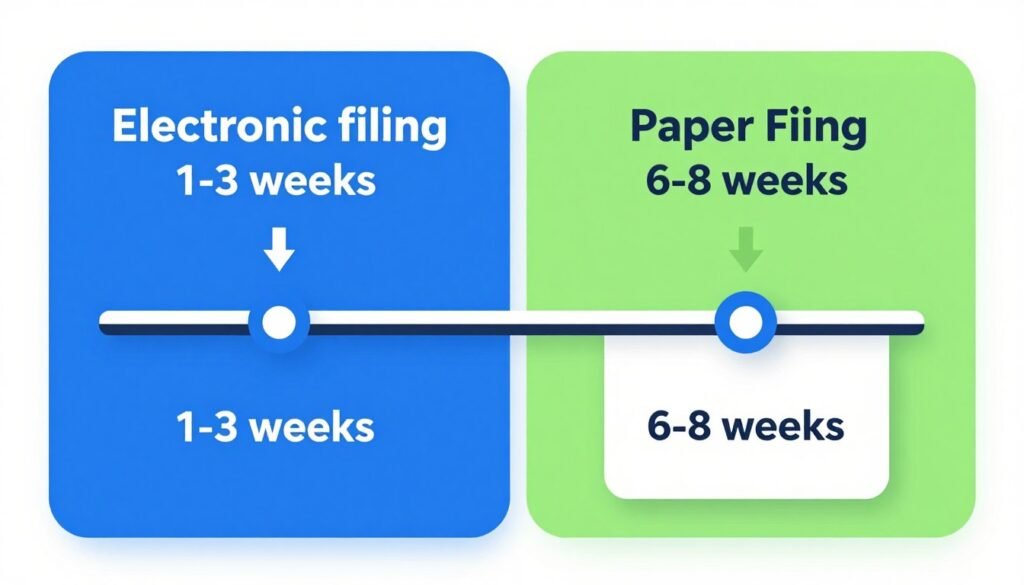
E-filed returns with direct deposit typically process within 21 days. This represents the standard timeframe for most taxpayers without complications.
Many electronic filers receive their refunds in just 10 to 14 days. The IRS processes e-filed returns in batches throughout each business day. Simple returns with no red flags move through the system fastest.
The three-week estimate includes weekends and holidays. Actual processing happens only on IRS business days. Filing early in the season often results in faster processing.
Paper Filing Processing Times
Paper tax returns require six to eight weeks for processing under normal circumstances. The IRS states this timeline clearly on its official guidance.
Some paper filers wait even longer during peak tax season. The agency processes millions of returns between January and April. Manual data entry creates bottlenecks that extend processing time.
Paper returns face additional delays if corrections are needed. The IRS must mail notices to taxpayers. Responses travel back through postal mail, adding weeks to the timeline.
Direct Deposit vs Paper Check
Your refund delivery method adds another layer to processing time. Direct deposit delivers funds within one to three business days after approval.
Paper checks require printing and mailing. This adds five to seven business days to your refund timeline. The postal service delivery time varies by location.
Combining e-filing with direct deposit creates the fastest possible refund scenario. Paper filing with a mailed check represents the slowest option, often exceeding two months total.
E-Filing Timeline
Electronic filing offers the fastest processing with automated systems handling most returns efficiently.
- Return received instantly by IRS
- Automated processing begins same day
- Average approval within 2-3 weeks
- Direct deposit within 1-3 business days
Paper Filing Timeline
Traditional paper filing requires significantly more time due to manual processing requirements.
- Mail delivery takes 3-7 business days
- Manual data entry by IRS staff
- Processing requires 6-8 weeks minimum
- Paper check mailing adds 5-7 days
Peak Season Impact
Filing during busy periods affects processing times differently for each method.
- E-filing delays rarely exceed one week
- Paper filing can extend to 12+ weeks
- March and April show longest wait times
- Early filing in January processes fastest
Special Circumstances
Certain tax situations require additional review time regardless of filing method.
- Earned Income Tax Credit claims add review time
- Amended returns always take longer
- Identity verification can delay refunds 9+ weeks
- Missing information requires correspondence delays
Tracking Your Refund Status
The IRS provides the “Where’s My Refund?” tool online. E-filers can check status within 24 hours of submission. Paper filers must wait four weeks before status information appears.
The tracking system updates once daily, usually overnight. It shows three stages: return received, refund approved, and refund sent. E-filed returns move through these stages much faster.
Who Benefits Most from Each Filing Method

Different taxpayers have different needs when it comes to filing taxes. Your personal situation determines which method serves you best.
Individual Taxpayers
Most individual filers benefit significantly from e-filing. Single taxpayers with W-2 income and standard deductions complete returns quickly online.
Young professionals typically prefer electronic filing for its speed and convenience. The process takes 30 minutes or less for simple returns. Refunds arrive faster, helping with student loans or savings goals.
Retirees with straightforward income sources also find e-filing advantageous. Social Security income and basic investment returns process smoothly through tax software. The faster refund helps with fixed-income budgeting.
Families with Children
Families claiming dependents see major advantages with e-filing. Child Tax Credits and dependent care deductions require accurate calculations. Software automatically computes these benefits correctly.
Parents relying on tax refunds for major expenses need faster processing. Summer camps, back-to-school shopping, and family vacations often depend on refund timing. E-filing delivers money weeks earlier than paper filing.
Large families with multiple children face complex returns. E-filing software handles multiple dependents seamlessly. The system prevents common errors that delay paper-filed family returns.
Small Business Owners
Self-employed individuals and small business owners handle complicated tax situations. E-filing software designed for business tax returns manages Schedule C income and expenses efficiently.
Business owners need quick refunds to maintain cash flow. Waiting two months for a paper refund creates financial strain. Electronic filing with direct deposit provides working capital faster.
Quarterly estimated tax payments complicate annual returns. E-filing systems track these payments automatically. Paper filers must manually reconcile estimated payments, increasing error risk.
First-Time Filers
New taxpayers often feel intimidated by the tax process. E-filing software guides first-timers through every question step-by-step. Built-in help explanations clarify confusing terms.
Young adults filing their first return make frequent mistakes on paper forms. Electronic systems catch errors before submission. This prevents delays and correspondence from the IRS.
Many first-time filers qualify for Free File programs. The IRS partners with software companies to offer free e-filing. Income limits determine eligibility, but millions qualify each year.
Complex Tax Situations
Taxpayers with investment income, rental properties, or multiple income sources face lengthy returns. Tax software handles complexity better than manual paper filing.
Those claiming itemized deductions benefit from electronic calculations. Mortgage interest, charitable donations, and medical expenses require precise math. Software eliminates calculation errors.
People who experience major life changes during the tax year need careful filing. Marriage, divorce, home purchases, or job changes affect tax liability. E-filing platforms ask targeted questions based on your responses.
Common Mistakes to Avoid When Choosing Your Filing Method

Many taxpayers make avoidable errors that delay their refunds or create problems with the IRS. Understanding these mistakes helps you file successfully.
Choosing Paper Filing for the Wrong Reasons
Some people believe paper filing is more secure than electronic filing. This misconception costs them weeks of refund time. The IRS uses bank-level encryption for e-filed returns.
Others think paper filing saves money by avoiding software costs. However, free e-filing options exist for most taxpayers. The IRS Free File program covers people earning less than $79,000 annually.
Fear of technology stops many from e-filing. Tax software now offers phone support and live chat help. The guidance available exceeds what you get with paper forms.
Missing the E-Filing Deadline
E-filing has the same deadline as paper filing: April 15th in most years. Some taxpayers incorrectly believe e-filing extends this date. Both methods face identical submission deadlines.
Last-minute filers rushing to meet the deadline benefit from e-filing. You can submit returns until 11:59 PM on deadline day. Paper returns must reach the IRS processing center by the deadline.
Filing for an extension works better electronically. You receive instant confirmation of your extension request. Paper extension requests lack verification until processed weeks later.
Not Keeping Documentation
Paper filers often believe they need to mail supporting documents with returns. This creates unnecessary delays and risks. The IRS specifically instructs taxpayers not to attach most documentation.
E-filers sometimes fail to save their tax files and receipts. You must maintain records for three years minimum. Download and store your e-filed return and all supporting documents.
Both filing methods require the same recordkeeping standards. Keep W-2s, 1099s, receipts, and proof of deductions. The filing method doesn’t change documentation requirements.
Entering Incorrect Banking Information
Direct deposit errors cause significant refund delays. Transposed account numbers or routing numbers send refunds to wrong accounts. E-filers must double-check banking information carefully.
Some taxpayers use closed bank accounts for refund deposits. The IRS returns these funds by paper check, adding weeks to the process. Verify your account remains active before submitting.
Joint filers sometimes enter individual account information. Both spouses’ names should appear on the refund deposit account. Mismatched names trigger additional IRS review time.
Ignoring Math Errors on Paper Returns
Manual calculations on paper forms frequently contain mistakes. Simple addition or subtraction errors delay processing while the IRS makes corrections. These corrections can change your refund amount.
Tax bracket calculations confuse many paper filers. Applying the wrong tax rate to income creates significant errors. E-filing software automatically applies correct tax brackets based on income.
Credit and deduction calculations involve complex worksheets. Paper filers often miscalculate earned income credits or education credits. These mistakes trigger IRS reviews that extend processing time.
Filing Multiple Amended Returns
Discovering errors after filing happens to many taxpayers. Paper filers sometimes submit multiple amended returns trying to fix mistakes. This creates massive confusion in IRS processing.
E-filers can reject and resubmit returns before IRS acceptance. This prevents the need for amendments in many cases. Once accepted, both filing methods require formal amended return procedures.
Amended returns always take longer to process regardless of original filing method. The IRS needs 16 weeks or more for amendments. Getting your original return right matters tremendously.
Missing Out on Refund Tracking
Paper filers often don’t realize they can track refund status online. The “Where’s My Refund?” tool works for all filing methods. You need your Social Security number, filing status, and exact refund amount.
Some taxpayers check refund status too frequently. The system updates once every 24 hours. Checking multiple times daily provides no additional information and wastes your time.
Ignoring refund status altogether can cause problems. The IRS may need additional information or verification. Monitoring your refund status helps you respond quickly to any issues.
Tips to Get Your Refund Faster Using the Right Method

Maximizing your refund speed requires strategic decisions about filing method and timing. These practical strategies help you receive your money as quickly as possible.
Choose E-Filing with Direct Deposit
This combination represents the absolute fastest refund option available. E-filing eliminates mail delivery time and manual data entry. Direct deposit cuts out check printing and postal delivery.
Select direct deposit during the e-filing process. Enter your routing and account numbers carefully. One wrong digit sends your refund to the wrong place and adds weeks of delay.
Confirm your bank accepts direct deposits from the IRS. Most banks do, but some credit unions have specific requirements. A quick call to your financial institution prevents problems.
File Early in Tax Season
January filers experience the fastest processing times. The IRS processes fewer returns in early weeks. Your return moves through the system with less competition.
Wait until you receive all tax documents before filing. W-2s arrive by January 31st. 1099 forms have the same deadline. Filing with incomplete information creates amendment headaches later.
Early filing also protects against identity theft. Criminals filing fraudulent returns in your name cannot succeed if you filed first. Your legitimate return establishes your claim to any refund.
Verify All Information Before Submitting
Accuracy matters more than speed when filing taxes. Review every entry on your return carefully. Mistakes delay processing regardless of filing method.
Check Social Security numbers for yourself, your spouse, and all dependents. Transposed digits trigger immediate IRS rejection for e-filed returns. Paper returns with wrong numbers face weeks of additional processing.
Compare your tax documents to your entries. Ensure W-2 wages match your return exactly. Differences between employer reporting and your return create automatic review flags.
Use IRS Free File or Reputable Software
The IRS partners with tax software companies for free e-filing. If you earned less than $79,000, you qualify for completely free preparation and filing.
Paid software offers additional features and support. Choose established providers with strong security records. Look for IRS e-file certification and bank-level encryption.
Many tax software companies guarantee accuracy. They cover penalties and interest if their software makes calculation errors. This protection exceeds what paper filing offers.
Avoid Refund Anticipation Loans
Some tax preparers offer loans against your expected refund. These products charge high fees and interest rates. E-filing delivers your actual refund almost as quickly.
Refund anticipation loans cost $30 to $50 for a two-week loan. Your refund arrives in three weeks through normal e-filing. The extra week doesn’t justify the expense.
Direct deposit of your e-filed refund provides free access to your money. Banks don’t charge for receiving IRS deposits. Skip expensive loan products entirely.
Check Your Refund Status Regularly
The IRS “Where’s My Refund?” tool provides real-time status updates. Access it 24 hours after e-filing or four weeks after mailing paper returns.
The system shows three status stages: return received, refund approved, and refund sent. Most e-filed returns move through all three stages within 21 days.
If your refund status doesn’t change for several weeks, call the IRS. Extended processing often indicates the agency needs additional information from you. Responding quickly resolves issues faster.
Maintain Digital and Physical Records
Save confirmation emails from e-filing submissions. These prove you filed on time if questions arise. Screenshot your submission confirmation page as well.
Download PDF copies of your completed return. Store them securely for at least three years. Cloud storage with encryption provides excellent security for tax documents.
Keep all supporting documents even with e-filing. W-2s, 1099s, receipts, and deduction proof remain important. The IRS may request documentation during audits occurring years after filing.
Real-World Refund Timeline Comparison
Seeing actual timelines helps you understand the practical difference between filing methods. These realistic scenarios show what taxpayers experience during typical tax seasons.
Scenario 1: E-Filing with Direct Deposit
Sarah, a marketing manager, receives her W-2 on January 25th. She has student loan interest, standard deduction, and one dependent child.
January 27th: Sarah completes her return using tax software. The process takes 45 minutes. She submits electronically at 8 PM.
January 28th: The IRS sends acceptance confirmation via email. Sarah can track her refund status starting this date.
February 10th: Her refund status changes to “approved.” The IRS scheduled her direct deposit payment.
February 13th: Sarah’s $2,450 refund appears in her checking account. Total time from filing to refund: 17 days.
Scenario 2: Paper Filing with Mailed Check
Michael, a freelance consultant, prefers paper forms. He has similar income and deductions as Sarah. He completes his return by hand.
February 1st: Michael mails his completed paper return via certified mail. Postage and certification cost $8.75.
February 5th: The IRS processing center receives his return. It enters a queue for manual data entry.
February 20th: IRS staff begins entering Michael’s return into the computer system. This takes three business days due to workload.
March 15th: Michael’s refund receives final approval. The IRS prints and mails his check.
March 22nd: Michael receives his $2,450 refund check in the mail. Total time from filing to refund: 49 days.
Time Difference Analysis
Sarah received her money 32 days faster than Michael. Both filed similar returns with identical refund amounts. The only difference was filing method.
Sarah spent no money on postage or certification. Michael paid $8.75 for secure mailing. His paper method cost money and time.
Sarah confirmed IRS receipt within 24 hours. Michael waited weeks before checking refund status. The uncertainty created additional stress.
| Timeline Stage | E-Filing (Sarah) | Paper Filing (Michael) | Time Difference |
| Return Submission | January 27th, 8:00 PM | February 1st (mailed) | 5 days later |
| IRS Receipt | January 27th, 8:01 PM | February 5th | 9 days later |
| Processing Start | January 28th | February 20th | 23 days later |
| Refund Approval | February 10th | March 15th | 33 days later |
| Money Received | February 13th | March 22nd | 37 days later |
| Total Timeline | 17 days | 49 days | 32 days slower |
Financial Impact of Delay
The 32-day delay cost Michael opportunity costs. If he earned 5% annual interest in a savings account, the delay represented about $10.50 in lost interest on his $2,450 refund.
More importantly, Michael planned to use his refund for a car down payment. The delay forced him to postpone the purchase. He missed a limited-time 0% financing offer worth hundreds of dollars.
Sarah used her faster refund to pay off high-interest credit card debt. She saved $45 in interest charges by paying the balance a month earlier.
Future Tax Filing Trends and Changes
Tax filing continues evolving with technology and changing IRS priorities. Understanding upcoming trends helps you prepare for future tax seasons.
IRS Modernization Initiatives
The IRS received significant funding for technology upgrades. These improvements focus on faster processing and better taxpayer service. E-filing systems will become even more efficient.
New artificial intelligence tools will catch errors and fraud faster. This speeds up legitimate refunds while blocking fraudulent returns. Honest taxpayers benefit from enhanced security measures.
The agency plans to expand Free File eligibility. More taxpayers will qualify for completely free e-filing. Income thresholds may increase to cover additional filers.
Declining Paper Filing Rates
Paper filing continues dropping each year. Currently, only about 10% of taxpayers file paper returns. The IRS expects this number to fall below 5% within five years.
Processing centers for paper returns may consolidate. Fewer locations could mean longer processing times for remaining paper filers. This creates additional incentive to switch to electronic filing.
Some IRS offices may eventually stop accepting paper returns except in special circumstances. The agency hasn’t announced firm plans, but the trend moves clearly toward mandatory e-filing.
Mobile Filing Growth
More taxpayers complete their returns entirely on smartphones. Mobile tax apps now offer full functionality matching desktop software. This trend especially affects younger filers.
The IRS developed a mobile app for refund tracking and account management. Future versions may include filing capabilities. Government-provided free filing could expand through mobile platforms.
Voice-activated tax filing may emerge within the next decade. Taxpayers could complete simple returns through smart speakers. Complex returns still require traditional software or professional preparation.
Real-Time Refund Processing
The IRS tests instant refund systems for simple returns. Some e-filed returns with direct deposit may receive approval within 48 hours. This significantly improves the already fast e-filing timeline.
Blockchain technology might secure future tax transactions. Distributed ledger systems could verify returns and process refunds simultaneously. Implementation remains years away but shows processing potential.
Real-time income verification connects IRS systems directly to employers. Pre-filled returns based on employer reporting could eliminate manual data entry. Several other countries already use similar systems successfully.
Enhanced Identity Verification
Identity theft remains a significant concern for the IRS. New verification methods protect taxpayers while potentially slowing initial processing. Biometric authentication may become standard for e-filing.
Multi-factor authentication requirements will likely expand. E-filers may need to verify identity through multiple channels before submission. This adds security without significantly impacting refund speed.
Paper filing faces stricter identity checks due to higher fraud rates. Additional verification steps could extend paper processing times beyond current eight-week estimates.
Environmental and Cost Considerations
The IRS spends millions processing paper returns. Budget pressures may lead to fees for paper filing. E-filing could remain free while paper filing carries surcharges.
Environmental concerns support the move toward paperless filing. Millions of paper returns create substantial waste. Government sustainability initiatives favor electronic alternatives.
State tax agencies increasingly require e-filing for certain taxpayers. More states may mandate electronic filing for all but the simplest returns. Federal requirements might follow state examples.
Weighing the Advantages and Disadvantages

Every filing method has strengths and weaknesses. Understanding both sides helps you make an informed decision based on your specific needs.
E-Filing Advantages
- Refunds arrive in 10-21 days versus 6-8 weeks
- Instant confirmation of IRS receipt
- Built-in error checking prevents mistakes
- Free options available for most income levels
- Direct deposit option speeds final payment
- 24-hour submission capability on deadline day
- Automatic calculations eliminate math errors
- Secure encrypted transmission protects data
- Electronic recordkeeping simplifies storage
- Immediate refund status tracking available
E-Filing Disadvantages
- Requires internet access and basic computer skills
- Software costs money for high-income filers
- Some complex situations need professional help
- Privacy concerns about data transmission
- Technology failures can delay submission
- Learning curve for first-time software users
- Dependence on third-party software providers
- Account creation requirements for some platforms
Paper Filing Advantages
- No computer or internet required
- Physical paper trail for all submissions
- Works for all tax situations without software limits
- No technology learning curve needed
- Free if you complete forms yourself
- Complete control over document handling
- Certified mail provides delivery proof
Paper Filing Disadvantages
- Refunds take 6-8 weeks minimum to receive
- No instant confirmation from IRS
- High error rate from manual calculations
- Postage costs for certified mailing
- Mail delivery delays beyond your control
- Cannot track refund for first four weeks
- Higher audit risk due to error frequency
- Lost mail means starting over completely
- Manual correction delays extend processing time
- Physical storage requirements for years of returns
Making Your Decision
Your personal circumstances determine the best filing method. Consider your timeline needs, comfort with technology, and financial situation.
If you need your refund quickly, e-filing clearly wins. The time difference exceeds one month in most cases. Financial emergencies or planned major purchases demand faster processing.
Technology access matters for e-filing. You need reliable internet and a compatible device. Public libraries offer free computer access if you lack home technology.
Complex tax situations may require professional help regardless of filing method. Tax preparers typically e-file on your behalf. Their fees include software costs and error protection.
Security and Accuracy Factors

Both filing methods face security and accuracy challenges. Understanding the risks helps you protect yourself and file correctly.
E-Filing Security Measures
The IRS uses 256-bit encryption for all e-filed returns. This matches the security level major banks use for online transactions. Your data transmits through secure channels.
Approved tax software providers undergo rigorous IRS certification. They must meet strict security standards annually. Regular audits ensure continued compliance with data protection rules.
Multi-factor authentication protects your tax software account. You verify your identity through passwords plus phone codes or email confirmations. This prevents unauthorized access to your return.
Paper Filing Security Risks
Mailed returns travel through multiple postal facilities. Each transfer point creates potential for loss or theft. Personal information sits readable on physical documents.
Identity thieves target tax season mail specifically. Stealing mailed returns provides complete personal and financial data. This information enables comprehensive identity fraud.
IRS processing centers receive millions of paper returns. Document security depends on facility controls and staff integrity. While generally secure, physical documents face more vulnerability than encrypted files.
Accuracy Comparison
E-filing software catches common errors before submission. The system alerts you to missing information, calculation mistakes, and inconsistencies. This dramatically reduces error rates.
Paper filers make math errors on approximately 20% of returns. The IRS must correct these mistakes manually. Some errors reduce your refund or increase tax owed.
Automated e-filing systems apply current tax law automatically. Tax brackets, standard deductions, and credit amounts update each year in the software. Paper filers must research these figures manually.
Fraud Prevention
The IRS rejects duplicate e-filed returns immediately. If someone files fraudulently using your Social Security number first, you receive instant notification. Quick response limits damage.
Paper filing delays fraud detection by weeks or months. The IRS discovers problems only during manual processing. By then, fraudulent refunds may already be paid.
E-filing systems verify Social Security numbers against government databases in real-time. Invalid numbers trigger immediate rejection. This prevents errors and fraud before the IRS accepts your return.
Special Tax Situations and Filing Method Selection
Certain tax situations influence which filing method works best. These scenarios require special consideration when choosing between e-filing and paper filing.
Amended Returns
Correcting a previously filed return requires Form 1040-X. The IRS now accepts e-filed amendments for most situations. This improves processing time from six months to four months.
Paper-filed amendments still work but take significantly longer. The manual processing required extends the already long amendment timeline. E-filing amendments whenever possible saves months of waiting time.
Some complex amendments still require paper filing. Certain attached schedules don’t support electronic submission. Check IRS guidelines for your specific amendment situation before choosing your method.
Prior Year Returns
Filing taxes for previous years almost always requires paper forms. Tax software typically covers only the current tax year. You must obtain prior-year forms from the IRS website.
Some tax professionals can e-file prior year returns using specialized software. This option costs more than current-year filing. The speed advantage still applies even for past years.
Multiple years of unfiled returns create backlogs in paper processing. The IRS handles these situations manually with extended review periods. Expect six months or longer for processing.
International Income
Taxpayers with foreign income face complex reporting requirements. Foreign bank accounts, overseas employment, and international investments require additional forms.
E-filing supports most international tax situations. Forms like FBAR and FATCA reports can be submitted electronically. This maintains the speed advantage of electronic filing.
Some foreign income situations still require paper filing. Specialized tax treaties or unusual income sources may lack e-filing support. Consult a tax professional familiar with international taxation.
Deceased Taxpayers
Final returns for deceased individuals can be e-filed by authorized representatives. The estate executor signs electronically using a special PIN. This provides faster refund processing for estates.
Paper filing remains common for deceased taxpayer returns. Some executors prefer physical documentation for estate records. Either method works legally if properly authorized.
Death certificate copies must accompany refund claims exceeding certain amounts. These attachments require paper filing in some cases. The IRS provides specific guidance for estate tax situations.
State Tax Filing Coordination
Federal filing method affects your state tax return process. Most states follow federal filing procedures but maintain separate requirements.
State E-Filing Programs
Most states accept e-filed state returns. Many tax software programs bundle federal and state filing together. This provides consistent speed advantages for both returns.
State processing times typically match federal timelines. E-filed state returns with direct deposit arrive in two to three weeks. Paper state returns take four to eight weeks.
Some states mandate e-filing for certain taxpayers. Businesses and high-income individuals face requirements in various states. Check your state’s revenue department for specific rules.
Combined Filing Benefits
Filing federal and state returns together through tax software saves time. Your federal information automatically populates state forms. This eliminates duplicate data entry.
Combined e-filing provides one confirmation for both returns. You track federal and state refunds through integrated systems. The convenience exceeds filing separately.
Some states offer free e-filing when you e-file your federal return. These partnerships reduce total filing costs. Paper filing both returns offers no comparable savings.
Making Your Filing Decision for Fastest Refunds

The choice between e-file vs paper filing tax refund methods significantly impacts your timeline. Electronic filing delivers refunds approximately 32 days faster than paper filing for most taxpayers.
E-filing combined with direct deposit represents the fastest possible option. Your return processes in 10 to 21 days typically. Paper filing with mailed checks extends this timeline to six to eight weeks or longer.
The speed difference only tells part of the story. E-filing provides accuracy advantages through built-in error checking. You receive instant confirmation and can track your refund within 24 hours.
Free e-filing options exist for the majority of taxpayers. The IRS Free File program covers incomes up to $79,000 annually. Paid software costs less than the value of receiving your refund weeks earlier.
Security concerns about electronic filing largely prove unfounded. The IRS uses bank-level encryption and rigorous security protocols. Paper returns face higher theft and fraud risks during mail delivery.
Your personal situation determines the best filing method. Most taxpayers benefit from e-filing’s speed and convenience. Complex returns may need professional preparation, but pros typically e-file on your behalf.
Technology requirements for e-filing remain minimal. Basic internet access and a smartphone or computer suffice for most returns. Public libraries provide free access if you lack home technology.
Plan your filing strategy early in tax season. Gather all documents before starting your return. File as soon as you have complete information to maximize refund speed.
The trend toward electronic filing continues accelerating. The IRS invests heavily in faster e-filing systems. Future improvements will make electronic filing even more attractive.
Don’t let unnecessary delays cost you weeks of waiting for your refund. Choose e-filing with direct deposit for the fastest, safest, and most accurate tax filing experience available today.