The New York State Tax Brackets for 2026: What You Need to Know
Understanding New York State tax brackets is essential for effective financial planning. As we look ahead to the 2026 tax year, staying informed about the state’s progressive tax structure can help you make strategic decisions to optimize your tax situation. This guide provides a comprehensive overview of the projected New York State tax brackets for 2026, comparing them with previous years and offering practical strategies to help you navigate your tax obligations efficiently.
The 2026 New York State Tax Brackets
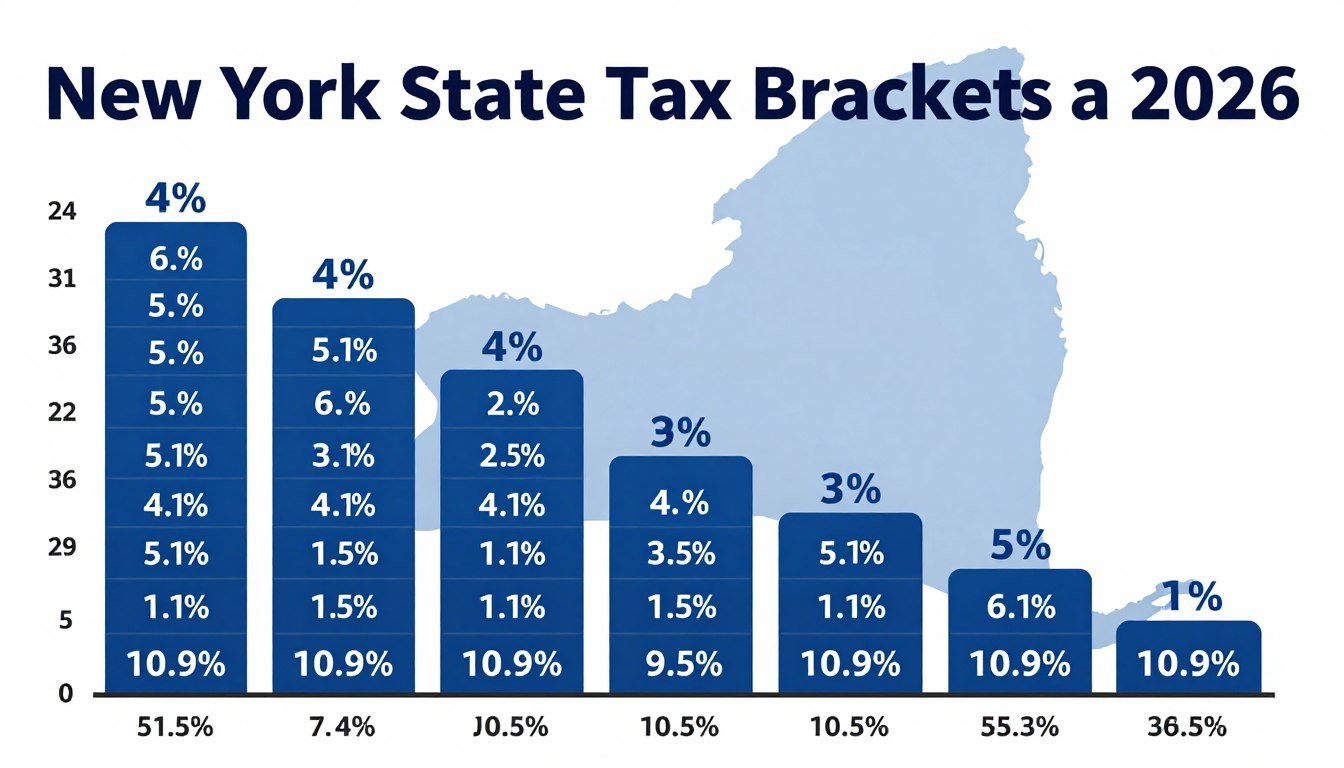
New York State employs a progressive tax system with nine income tax rates ranging from 4% to 10.9%. The tax brackets for 2026 are projected based on the 2025 brackets with adjustments for inflation. The New York State Department of Taxation and Finance typically announces the official brackets in late 2025, but we can use the current information as a reliable baseline for planning purposes.
New York State’s progressive tax structure features nine tax brackets for 2026
Single Filers and Married Filing Separately (2026 Projected)
| Taxable Income Bracket | Tax Rate | Tax Owed |
| $0 to $12,400 | 4% | 4% of taxable income |
| $12,401 to $13,900 | 4.5% | $496 plus 4.5% of amount over $12,400 |
| $13,901 to $16,100 | 5.25% | $564 plus 5.25% of amount over $13,900 |
| $16,101 to $82,500 | 5.5% | $680 plus 5.5% of amount over $16,100 |
| $82,501 to $220,000 | 6% | $4,322 plus 6% of amount over $82,500 |
| $220,001 to $1,100,000 | 6.85% | $12,572 plus 6.85% of amount over $220,000 |
| $1,100,001 to $5,100,000 | 9.65% | $72,847 plus 9.65% of amount over $1,100,000 |
| $5,100,001 to $25,500,000 | 10.3% | $458,847 plus 10.3% of amount over $5,100,000 |
| $25,500,001 and over | 10.9% | $2,550,047 plus 10.9% of amount over $25,500,000 |
Married Filing Jointly and Qualifying Surviving Spouse (2026 Projected)
| Taxable Income Bracket | Tax Rate | Tax Owed |
| $0 to $24,800 | 4% | 4% of taxable income |
| $24,801 to $27,900 | 4.5% | $992 plus 4.5% of amount over $24,800 |
| $27,901 to $32,200 | 5.25% | $1,132 plus 5.25% of amount over $27,900 |
| $32,201 to $165,000 | 5.5% | $1,358 plus 5.5% of amount over $32,200 |
| $165,001 to $330,000 | 6% | $8,734 plus 6% of amount over $165,000 |
| $330,001 to $2,200,000 | 6.85% | $18,634 plus 6.85% of amount over $330,000 |
| $2,200,001 to $5,100,000 | 9.65% | $146,644 plus 9.65% of amount over $2,200,000 |
| $5,100,001 to $25,500,000 | 10.3% | $426,644 plus 10.3% of amount over $5,100,000 |
| $25,500,001 and over | 10.9% | $2,518,044 plus 10.9% of amount over $25,500,000 |
Head of Household (2026 Projected)
| Taxable Income Bracket | Tax Rate | Tax Owed |
| $0 to $18,600 | 4% | 4% of taxable income |
| $18,601 to $20,900 | 4.5% | $744 plus 4.5% of amount over $18,600 |
| $20,901 to $24,150 | 5.25% | $848 plus 5.25% of amount over $20,900 |
| $24,151 to $123,750 | 5.5% | $1,019 plus 5.5% of amount over $24,150 |
| $123,751 to $275,000 | 6% | $6,512 plus 6% of amount over $123,750 |
| $275,001 to $1,650,000 | 6.85% | $15,587 plus 6.85% of amount over $275,000 |
| $1,650,001 to $5,100,000 | 9.65% | $109,737 plus 9.65% of amount over $1,650,000 |
| $5,100,001 to $25,500,000 | 10.3% | $442,737 plus 10.3% of amount over $5,100,000 |
| $25,500,001 and over | 10.9% | $2,534,137 plus 10.9% of amount over $25,500,000 |
Important Note: The above brackets are projections based on the 2025 tax year with estimated inflation adjustments. The official 2026 tax brackets will be released by the New York State Department of Taxation and Finance in late 2025. Always refer to the official source for the most accurate and up-to-date information.
Comparison with the Previous Year (2025)
Understanding how tax brackets change from year to year can help you plan more effectively. Below is a comparison between the 2025 and projected 2026 tax brackets for single filers, highlighting the differences due to inflation adjustments.
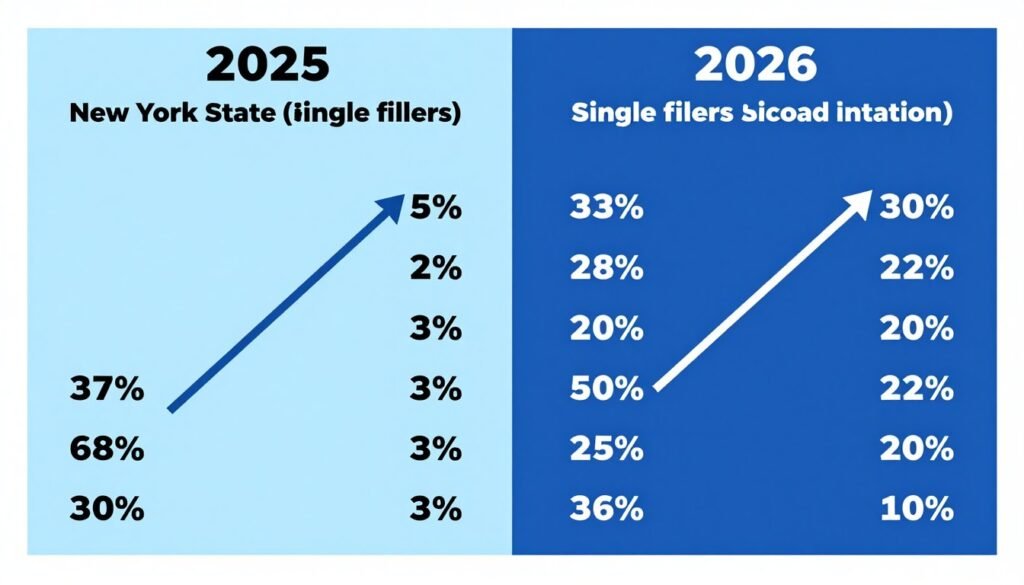
Comparison of 2025 vs. projected 2026 tax brackets showing inflation adjustments
Single Filers Comparison (2025 vs. 2026 Projected)
| Tax Rate | 2025 Income Bracket | 2026 Projected Income Bracket | Difference |
| 4% | $0 to $11,925 | $0 to $12,400 | +$475 |
| 4.5% | $11,926 to $13,900 | $12,401 to $13,900 | Threshold +$475 |
| 5.25% | $13,901 to $16,100 | $13,901 to $16,100 | No change |
| 5.5% | $16,101 to $80,650 | $16,101 to $82,500 | Upper limit +$1,850 |
| 6% | $80,651 to $215,400 | $82,501 to $220,000 | Threshold +$1,850, Upper limit +$4,600 |
| 6.85% | $215,401 to $1,077,550 | $220,001 to $1,100,000 | Threshold +$4,600, Upper limit +$22,450 |
| 9.65% | $1,077,551 to $5,000,000 | $1,100,001 to $5,100,000 | Threshold +$22,450, Upper limit +$100,000 |
| 10.3% | $5,000,001 to $25,000,000 | $5,100,001 to $25,500,000 | Threshold +$100,000, Upper limit +$500,000 |
| 10.9% | $25,000,001 and over | $25,500,001 and over | Threshold +$500,000 |
Practical Impact Analysis
To understand how these changes affect real taxpayers, let’s examine a few scenarios:
Single Filer Earning $75,000
2025 Tax Calculation:
- 4% on first $11,925 = $477
- 4.5% on $11,926 to $13,900 = $89
- 5.25% on $13,901 to $16,100 = $115
- 5.5% on $16,101 to $75,000 = $3,240
- Total 2025 Tax: $3,921
2026 Projected Tax Calculation:
- 4% on first $12,400 = $496
- 4.5% on $12,401 to $13,900 = $68
- 5.25% on $13,901 to $16,100 = $115
- 5.5% on $16,101 to $75,000 = $3,240
- Total 2026 Tax: $3,919
Difference: $2 less in 2026
Married Couple Filing Jointly Earning $150,000
2025 Tax Calculation:
- 4% on first $23,850 = $954
- 4.5% on $23,851 to $27,900 = $182
- 5.25% on $27,901 to $32,200 = $226
- 5.5% on $32,201 to $150,000 = $6,479
- Total 2025 Tax: $7,841
2026 Projected Tax Calculation:
- 4% on first $24,800 = $992
- 4.5% on $24,801 to $27,900 = $140
- 5.25% on $27,901 to $32,200 = $226
- 5.5% on $32,201 to $150,000 = $6,479
- Total 2026 Tax: $7,837
Difference: $4 less in 2026
While the differences may seem small in these examples, the impact of inflation adjustments becomes more significant at higher income levels and over multiple years. These adjustments help prevent “bracket creep,” where inflation pushes taxpayers into higher tax brackets even when their purchasing power hasn’t increased.
Maximizing Your Refund / Minimizing Liability for 2026
Strategic tax planning can help you reduce your New York State tax liability for 2026. Here are some effective strategies to consider:
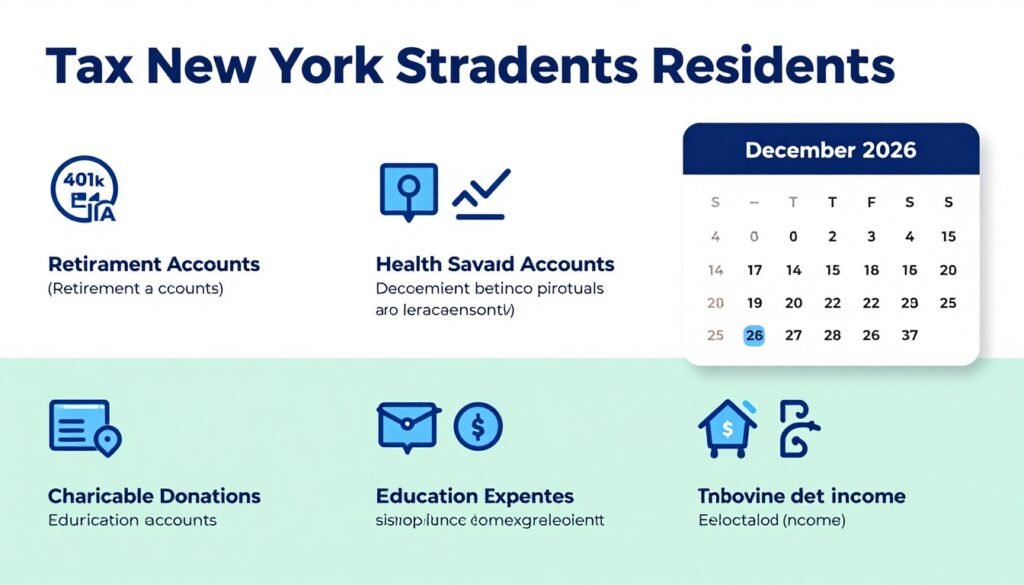
Strategic tax planning can help minimize your New York State tax liability
Pre-Tax Contribution Strategies
Retirement Accounts
- 401(k) Contributions: Contribute up to the maximum allowed ($23,000 for 2025, with likely increases for 2026) to reduce your taxable income.
- Traditional IRA: Consider contributing to a traditional IRA if you’re eligible. For 2025, the contribution limit is $7,000 ($8,000 if you’re 50 or older), with potential increases for 2026.
- SEP IRA or Solo 401(k): Self-employed individuals can make substantial pre-tax contributions to these accounts, potentially reducing their tax bracket.
Health Accounts
- Health Savings Account (HSA): If you have a high-deductible health plan, contribute to an HSA. The 2025 contribution limit is $4,150 for individuals and $8,300 for families, with an additional $1,000 catch-up contribution for those 55 and older.
- Flexible Spending Account (FSA): Contribute to your employer’s FSA for healthcare or dependent care expenses. The 2025 limit for healthcare FSAs is $3,200, with potential increases for 2026.
New York-Specific Deductions and Credits
Available Deductions
- College Tuition Credit/Deduction: New York offers a tuition tax credit of up to $400 per student or a deduction of up to $10,000 per student.
- Long-Term Care Insurance: You can deduct a percentage of qualified long-term care insurance premiums.
- Pension and Annuity Income Exclusion: If you’re 59½ or older, you can exclude up to $20,000 of qualified pension and annuity income from your state taxable income.
- New York’s 529 College Savings Program: Contributions to New York’s 529 plan are deductible up to $5,000 annually ($10,000 for married couples filing jointly).
Available Credits
- Empire State Child Credit: Worth up to $330 per qualifying child aged 4-16.
- New York State Earned Income Credit: Equal to 30% of the federal EITC.
- Child and Dependent Care Credit: Based on the federal credit but potentially more generous.
- Real Property Tax Credit: Available for low-income homeowners and renters.
- Solar Energy System Equipment Credit: Equal to 25% of qualified solar energy expenses up to $5,000.
Income and Expense Timing Strategies
Strategic timing of income and expenses can help you manage which tax year they fall into:
Income Timing
- Defer Income: If possible, defer year-end bonuses or freelance payments to January 2027 if you expect to be in a lower tax bracket that year.
- Accelerate Income: Conversely, if you expect to be in a higher tax bracket in 2027, consider accelerating income into 2026.
- Harvest Investment Losses: Offset capital gains by selling investments that have lost value, potentially reducing your overall taxable income.
Expense Timing
- Bunch Itemized Deductions: Consider “bunching” deductible expenses into a single tax year to exceed the standard deduction threshold.
- Accelerate Charitable Contributions: Make planned 2027 charitable donations in late 2026 to increase your 2026 deductions.
- Prepay Deductible Expenses: Consider prepaying deductible expenses like January mortgage payments or property taxes in December 2026.
Filing Status Considerations
Your filing status can significantly impact your tax liability:
| Filing Status | Considerations for New York Taxes |
| Single | Standard deduction of $8,000 for 2025 (projected $8,250 for 2026). Higher tax rates apply at lower income thresholds compared to joint filers. |
| Married Filing Jointly | Standard deduction of $16,050 for 2025 (projected $16,500 for 2026). Income thresholds for tax brackets are generally double those for single filers, which can result in tax savings for couples with disparate incomes. |
| Married Filing Separately | Standard deduction of $8,000 for 2025 (projected $8,250 for 2026). May be beneficial in specific situations, such as when one spouse has significant medical expenses or when couples have similar income levels and both are high earners. |
| Head of Household | Standard deduction of $11,200 for 2025 (projected $11,550 for 2026). More favorable tax brackets than single filers, beneficial for unmarried individuals who maintain a household for a qualifying dependent. |
Standard Deduction vs. Itemizing: For 2026, carefully evaluate whether to take the standard deduction or itemize deductions on your New York return. Unlike federal returns, New York requires you to use the same method (standard or itemized) that you use on your federal return. If your itemized deductions exceed your standard deduction amount, itemizing could result in significant tax savings.
Special Considerations for New York City Residents
New York City imposes an additional income tax on its residents, which must be considered alongside state taxes for comprehensive tax planning.
New York City residents pay additional local income tax on top of state taxes
New York City Income Tax Rates (2026 Projected)
| Filing Status | Taxable Income | NYC Tax Rate |
| Single or Married Filing Separately | $0 to $12,500 | 3.078% |
| $12,501 to $25,500 | 3.762% | |
| $25,501 to $50,500 | 3.819% | |
| Over $50,500 | 3.876% | |
| Married Filing Jointly or Qualifying Widow(er) | $0 to $21,600 | 3.078% |
| $21,601 to $45,000 | 3.762% | |
| $45,001 to $90,000 | 3.819% | |
| Over $90,000 | 3.876% | |
| Head of Household | $0 to $14,400 | 3.078% |
| $14,401 to $30,000 | 3.762% | |
| $30,001 to $60,000 | 3.819% | |
| Over $60,000 | 3.876% |
Combined Tax Impact for NYC Residents
NYC residents should consider their combined state and city tax burden when planning. For example, a single NYC resident with taxable income of $100,000 in 2026 would face:
New York State Tax
- 4% on first $12,400 = $496
- 4.5% on $12,401 to $13,900 = $68
- 5.25% on $13,901 to $16,100 = $115
- 5.5% on $16,101 to $82,500 = $3,652
- 6% on $82,501 to $100,000 = $1,050
- Total NYS Tax: $5,381
New York City Tax
- 3.078% on first $12,500 = $385
- 3.762% on $12,501 to $25,500 = $489
- 3.819% on $25,501 to $50,500 = $954
- 3.876% on $50,501 to $100,000 = $1,919
- Total NYC Tax: $3,747
Combined NYS and NYC Tax: $9,128
NYC-Specific Tax Breaks
NYC residents should be aware of these city-specific tax benefits:
- NYC School Tax Credit: Available to NYC residents with incomes below certain thresholds.
- NYC Enhanced Real Property Tax Credit: For low-income NYC residents who pay rent or property taxes.
- NYC Child and Dependent Care Credit: Supplements the state and federal credits for qualifying expenses.
- NYC Earned Income Credit: Equal to 5% of the federal EITC for qualifying taxpayers.
Note for Yonkers Residents: Yonkers also imposes a local income tax on its residents. For 2026, Yonkers residents will pay an additional income tax equal to 16.75% of their New York State tax liability. Non-residents who work in Yonkers pay 0.5% of their Yonkers wages.
Local and Municipal Taxes
Beyond state income taxes and the additional taxes imposed by New York City and Yonkers, New York State allows local jurisdictions to levy various taxes that can affect your overall tax burden.
Property tax rates vary significantly across New York State counties
Property Taxes
Property taxes in New York are among the highest in the nation, with significant variation by location:
| County | Average Effective Property Tax Rate (2025) | Median Annual Property Tax |
| Westchester | 2.15% | $18,078 |
| Rockland | 2.24% | $13,931 |
| Nassau | 2.11% | $13,758 |
| Suffolk | 1.69% | $10,674 |
| Putnam | 1.82% | $10,523 |
| Albany | 1.56% | $5,089 |
| Erie | 1.73% | $4,300 |
| Hamilton (lowest) | 0.89% | $2,197 |
Property taxes are set by local governments, school districts, and special districts. To find the specific property tax rates for your area, visit the New York State Department of Taxation and Finance property tax calculator.
Sales Tax
New York has a statewide sales tax rate of 4%, but local jurisdictions can add their own sales tax, resulting in combined rates that vary across the state:
Highest Combined Sales Tax Rates
- New York City: 8.875% (4% state + 4.5% city + 0.375% Metropolitan Commuter Transportation District)
- Yonkers: 8.875% (4% state + 4.5% local + 0.375% MCTD)
- Mount Vernon: 8.875% (4% state + 4.5% local + 0.375% MCTD)
- White Plains: 8.375% (4% state + 4% local + 0.375% MCTD)
Lowest Combined Sales Tax Rates
- Saratoga County: 7% (4% state + 3% local)
- Warren County: 7% (4% state + 3% local)
- Schoharie County: 8% (4% state + 4% local)
- Ontario County: 7.5% (4% state + 3.5% local)
To find the current sales tax rate for any locality in New York, use the New York State Department of Taxation and Finance sales tax jurisdiction lookup tool.
Other Local Taxes
Depending on where you live in New York, you may be subject to additional local taxes:
- Metropolitan Commuter Transportation Mobility Tax (MCTMT): Self-employed individuals with net earnings exceeding $50,000 who work within the Metropolitan Commuter Transportation District (New York City, Long Island, and the lower Hudson Valley) pay this tax at rates ranging from 0.34% to 0.42%.
- Hotel Occupancy Tax: Varies by locality, with New York City charging 5.875% plus a flat fee per room per night.
- Restaurant Meals Tax: Some localities impose additional taxes on prepared food.
- Utility Taxes: Many municipalities charge taxes on utilities like electricity, gas, and telecommunications.
Local Tax Resources: For the most up-to-date information on local taxes in your specific area, visit the New York State Department of Taxation and Finance local tax rates page. You can search by county, city, town, or village to find the applicable tax rates for your location.
Projected Changes & Long-Term Outlook
Understanding potential future changes to New York’s tax system can help you plan more effectively for the long term. Here’s what we know about upcoming changes and what experts are projecting for New York’s tax future.
Projected timeline of New York State tax changes for 2026 and beyond
Confirmed Changes for 2026
- Inflation Adjustments: Tax brackets will be adjusted for inflation, as they are annually. The exact adjustment percentages will be announced in late 2025.
- Standard Deduction Increases: The standard deduction amounts are expected to increase slightly to account for inflation.
- SALT Deduction Cap: The federal cap on state and local tax (SALT) deductions is scheduled to increase from $10,000 to $40,000 for 2025, which will benefit many New York taxpayers with high property taxes and state income taxes.
Potential Legislative Changes
While not yet confirmed, these potential changes could affect New York taxpayers in 2026 and beyond:
State-Level Proposals
- Property Tax Relief: Ongoing discussions about expanding property tax relief programs, particularly for seniors and middle-income homeowners.
- Tax Credits for Families: Potential expansion of the Empire State Child Credit and other family-oriented tax benefits.
- Climate-Related Tax Incentives: Possible new or expanded tax credits for energy efficiency improvements and clean energy adoption.
Federal Changes Affecting NY
- Federal Tax Rates: Changes to federal tax rates could indirectly impact New York taxpayers, as federal taxable income is the starting point for calculating New York taxable income.
- Retirement Account Rules: Potential changes to retirement account contribution limits and required minimum distribution rules.
- Healthcare Tax Provisions: Possible adjustments to healthcare-related tax provisions that could affect New Yorkers.
Long-Term Tax Outlook for New York
Tax experts and economists suggest several trends that may shape New York’s tax landscape in the coming years:
“New York’s tax policy continues to evolve in response to economic conditions, demographic shifts, and competition with other states. While the state maintains one of the highest top marginal rates in the country, there’s increasing pressure to provide relief for middle-income taxpayers while ensuring fiscal stability.”
- Focus on Middle-Class Relief: Continued emphasis on providing tax relief for middle-income taxpayers while maintaining revenue from high-income earners.
- Digital Economy Taxation: Potential new approaches to taxing digital services and remote work as these continue to grow.
- Environmental Taxation: Possible introduction of carbon taxes or other environmental tax measures as part of climate initiatives.
- Property Tax Reform: Ongoing discussions about reforming New York’s property tax system, which is among the highest in the nation.
Stay Informed: Tax laws can change rapidly. For the most current information on New York State tax brackets and other tax matters, regularly check the New York State Department of Taxation and Finance website or consult with a tax professional who specializes in New York taxation.
Actionable Conclusion & Key Takeaways
Understanding New York State’s tax brackets for 2026 is essential for effective financial planning. While the official brackets will be released in late 2025, the projections provided in this guide offer a solid foundation for planning purposes.
Key takeaways for navigating New York State taxes in 2026
Summary of Key Changes for 2026
- Tax brackets will be adjusted for inflation, with thresholds increasing across all nine tax rates.
- The standard deduction is projected to increase slightly for all filing statuses.
- New York City residents will continue to pay additional local income tax on top of state taxes.
- The federal SALT deduction cap increase to $40,000 will benefit many New York taxpayers with high property taxes and state income taxes.
Action Steps for New York Taxpayers
- Determine your projected 2026 income. Estimate your total taxable income for 2026, including wages, investment income, retirement distributions, and other sources.
- Identify your tax bracket. Use the projected 2026 tax brackets in this guide to determine which marginal tax rate will apply to your income.
- Review your withholdings. Adjust your W-4 withholdings with your employer to ensure you’re having the appropriate amount withheld for state taxes.
- Maximize pre-tax contributions. Take full advantage of 401(k)s, IRAs, HSAs, and FSAs to reduce your taxable income.
- Consider timing strategies. Plan the timing of income and deductions to optimize your tax situation across tax years.
- Research local taxes. Understand the additional taxes that apply in your specific locality, including property taxes and sales taxes.
- Consult a tax professional. For personalized advice, consider working with a tax professional who specializes in New York taxation.
- Stay informed. Regularly check the New York State Department of Taxation and Finance website for updates on tax brackets, deductions, and credits.
Final Reminder: This guide provides projections based on current information. The official 2026 tax brackets will be released by the New York State Department of Taxation and Finance in late 2025. Always refer to official sources for the most accurate and up-to-date tax information.
By understanding New York’s tax brackets and planning accordingly, you can potentially reduce your tax liability while ensuring compliance with all state and local tax requirements. Taking a proactive approach to tax planning now can lead to significant savings when you file your 2026 tax return.