Refugee vs Asylum Status Differences: Complete Guide to Protection in the United States
Seeking protection in the United States can feel overwhelming. If you face persecution in your home country, understanding the refugee vs asylum status differences becomes critical to your safety.
Both pathways offer protection to individuals fleeing danger. However, the application process, eligibility requirements, and timelines differ significantly.
In 2026, immigration policies continue to evolve. Knowing which status fits your situation helps you make informed decisions about your future in the United States.
This guide breaks down everything you need to know. We explain both processes in simple terms, so you can choose the right path forward.
What Refugee and Asylum Status Mean
Understanding key immigration terms helps you navigate the protection system. Both refugees and asylum seekers flee persecution, but their legal definitions differ.
Definition of Refugee Status
A refugee is a person who cannot return to their home country due to well-founded fear of persecution. The United Nations definition requires this fear to relate to race, religion, nationality, political opinion, or membership in a particular social group.
Refugees apply for protection while outside the United States. The refugee resettlement process involves international organizations and the U.S. government.
Once admitted, refugees receive immediate authorization to work. They can apply for a green card after one year of physical presence in the United States.
Definition of Asylum Status
Asylum status protects individuals already in the United States or at a port of entry. An asylum seeker must prove the same well-founded fear of persecution based on protected grounds.
The key difference lies in location. Asylum seekers apply from within U.S. territory or at the border.
An asylee gains protection after approval. Like refugees, asylees can work immediately and apply for permanent residence after one year.
Key Differences Between Refugee and Asylum Status
Location of Application
Where you apply creates the primary distinction between these protection categories.
- Refugees apply from outside United States borders through resettlement programs
- Asylum seekers must be physically present in the United States or at a port of entry
- Refugees work with international agencies before arrival
- Asylum applicants file directly with U.S. immigration authorities
Application Process
The procedures for obtaining protection status vary significantly between pathways.
- Refugee applications involve United Nations referrals and security screenings abroad
- Asylum applications use Form I-589 submitted to USCIS or immigration court
- Refugees cannot choose their resettlement country
- Asylum seekers choose to seek protection in the United States specifically
Timeline Considerations
Processing times differ dramatically depending on your chosen protection pathway.
- Refugee processing typically takes 18 to 24 months from referral to arrival
- Asylum decisions can take months to years depending on case complexity
- Refugees receive travel arrangements and initial support upon arrival
- Asylum seekers must navigate the system while already in the country
Benefits and Rights
Both statuses provide protection, but the initial support structures differ.
- Refugees access resettlement assistance programs immediately upon arrival
- Asylees may face waiting periods before accessing certain federal benefits
- Both can eventually obtain green cards and pursue citizenship
- Work authorization comes immediately for both refugees and approved asylees
Requirements and Eligibility Criteria
Both refugee status and asylum require proof of persecution or well-founded fear. The U.S. government examines your individual circumstances carefully.
Refugee Status Eligibility
To qualify as a refugee, you must meet specific criteria established by U.S. immigration law. Your situation must demonstrate genuine persecution risk.
You cannot be firmly resettled in another country. Firm resettlement means you received permanent resident status or citizenship elsewhere.
- You must be outside the United States when applying for refugee status
- You face persecution based on race, religion, nationality, political opinion, or membership in a particular social group
- You cannot safely return to your home country or country of last residence
- You have not participated in persecution of others
- You pass security and medical screenings required by U.S. authorities
- A qualifying organization refers you, or you qualify as a Priority 2 case
The definition of refugee under U.S. law aligns with international standards. However, the United States sets annual refugee admission caps that affect processing.
Asylum Status Eligibility
Asylum seekers must apply within one year of arriving in the United States. Exceptions exist for changed circumstances or extraordinary conditions.
You must prove past persecution or a well-founded fear of future persecution. The fear must be objectively reasonable, not just subjective anxiety.
- You are physically present in the United States or seeking entry at a port of entry
- You apply within one year of your arrival, unless exceptions apply
- You demonstrate persecution or fear based on protected grounds (race, religion, nationality, political opinion, membership in particular social group)
- The persecution comes from your government or groups your government cannot control
- You cannot obtain protection by relocating within your home country
- You have not firmly resettled in another country before coming to the United States
- You do not pose security risks to the United States
Asylum seekers can apply affirmatively through USCIS or defensively in removal proceedings. The one-year deadline applies to affirmative applications.
Documents Needed for Applications
Gathering proper documentation strengthens your case significantly. Both processes require substantial evidence of your persecution claims.
- Referral from UNHCR or U.S. Embassy
- Identity documents (passport, birth certificate, national ID)
- Evidence of persecution or fear (police reports, medical records, witness statements)
- Family relationship documents for accompanying relatives
- Photographs meeting U.S. visa requirements
- Completed biographic information forms
- Medical examination results from approved physicians
Refugee Application Documents
- Form I-589, Application for Asylum and Withholding of Removal
- Two passport-style photographs
- Identity documents with English translations
- Detailed written statement describing persecution
- Country condition reports from State Department or human rights organizations
- Evidence supporting your fear (threats, medical records, news articles)
- Proof of one-year filing deadline compliance or exception eligibility
Asylum Application Documents
Step-by-Step Application Process
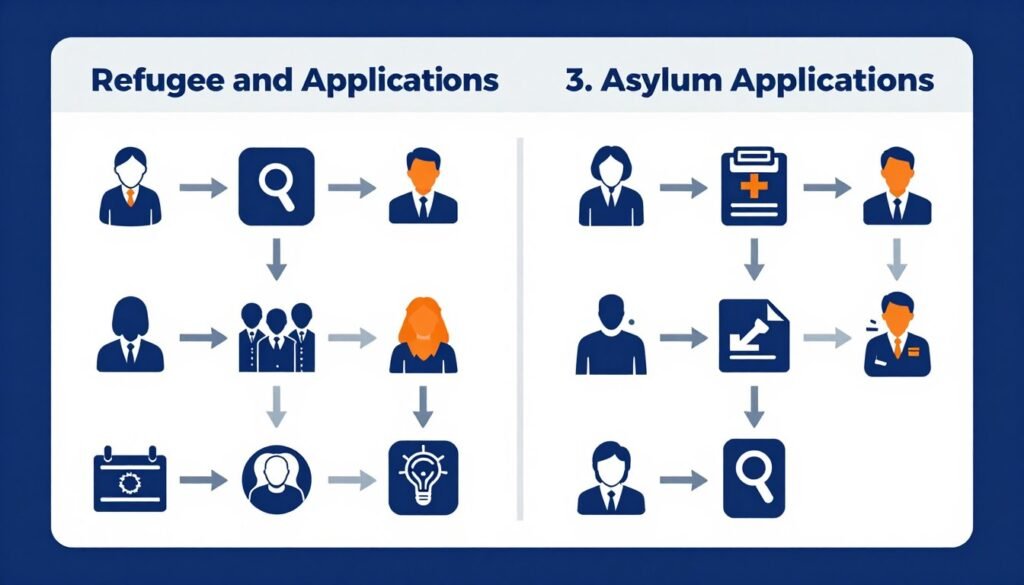
Understanding each step helps you prepare properly. The processes differ significantly in complexity and timeline.
How to Apply for Refugee Status
The refugee resettlement process begins outside the United States. You cannot apply directly without a referral.
- Register with the United Nations High Commissioner for Refugees (UNHCR) or a U.S. embassy in your location
- Receive referral to the U.S. Refugee Admissions Program (USRAP) if you meet criteria
- Complete initial interviews with a Resettlement Support Center (RSC)
- Undergo security screenings by multiple U.S. government agencies
- Attend in-person interview with USCIS officer (often conducted abroad)
- Complete required medical examinations with approved physicians
- Receive cultural orientation training about life in the United States
- Get matched with a resettlement agency in your destination U.S. city
- Receive travel arrangements and interest-free travel loan
- Arrive in the United States and begin resettlement process with local agency support
Refugees work with resettlement agencies upon arrival. These organizations help with housing, employment, and adjustment to American life.
How to Apply for Asylum Status
Asylum applications follow different procedures depending on your circumstances. You can apply affirmatively or defensively.
Affirmative Asylum Process:
- File Form I-589 with USCIS within one year of arriving in the United States
- Include all required supporting documents and evidence with your application
- Receive receipt notice confirming USCIS received your application
- Complete biometric services appointment for fingerprinting
- Attend asylum interview at a USCIS office with an asylum officer
- Wait for written decision (approval, referral to immigration court, or denial)
- If approved, receive Employment Authorization Document and asylee status
Defensive Asylum Process:
- Receive Notice to Appear (NTA) for removal proceedings
- File Form I-589 with immigration court, not USCIS
- Attend master calendar hearings to set individual hearing date
- Prepare evidence and testimony with legal representation
- Present your asylum case before an immigration judge
- Await judge’s written decision on your asylum application
- Appeal to Board of Immigration Appeals if denied
Most asylum seekers apply affirmatively first. If USCIS does not grant asylum, your case gets referred to immigration court for defensive proceedings.
Official Resources: The U.S. Citizenship and Immigration Services (USCIS) website provides current forms and filing instructions. Visit www.uscis.gov for the latest guidance. The U.S. Department of State offers information on refugee resettlement at www.state.gov.
Processing Time and Associated Costs
Processing times vary significantly between refugee and asylum pathways. Understanding these timelines helps you plan accordingly.
Refugee Processing Timeline
The refugee process typically takes 18 to 24 months from initial referral to arrival in the United States. Some cases take longer due to security clearances.
Processing involves multiple agencies and extensive background checks. The Department of Homeland Security conducts thorough security screenings on every refugee applicant.
- UNHCR registration and referral: 3-6 months
- Resettlement Support Center interview: 2-4 months
- Security screenings and background checks: 6-12 months
- USCIS officer interview: 2-3 months wait time
- Medical examination completion: 1-2 months
- Travel arrangements and cultural orientation: 1-2 months
Refugees do not pay application fees for their status. However, they receive travel loans that must be repaid over time.
Asylum Processing Timeline
Asylum processing times have increased substantially in recent years. Current wait times reflect significant case backlogs.
Affirmative asylum applications with USCIS currently average 2 to 5 years from filing to interview. Defensive cases in immigration court often take 3 to 6 years.
- Form I-589 filing to receipt notice: 2-4 weeks
- Biometric services appointment: 4-8 weeks after filing
- Asylum interview scheduling: 6 months to 4 years
- Decision after interview: 2 weeks to 6 months
- Immigration court proceedings (if referred): 2-5 years
- Work permit processing after 150 days: 3-6 months
The USCIS aims to schedule asylum interviews within 45 days under recent policy changes. However, actual wait times remain much longer due to backlog.
Application Fees and Costs
Understanding financial requirements helps you budget for the application process. Costs vary between refugee and asylum pathways.
| Cost Item | Refugee Status | Asylum Status |
| Application Fee | No fee | No fee for Form I-589 |
| Medical Examination | Covered by resettlement program | $200-$500 (applicant pays) |
| Travel to United States | Interest-free loan (must repay) | Applicant already in U.S. |
| Work Permit (EAD) | Not needed (can work immediately) | No fee with pending asylum |
| Legal Representation | Free through resettlement agencies | $3,000-$10,000 (recommended) |
| Document Translation | Provided by resettlement program | $50-$200 per document |
| Green Card Application (after 1 year) | No fee for refugees | No fee for asylees |
While asylum applications have no government filing fee, legal representation significantly improves approval chances. Many asylum seekers invest in qualified immigration attorneys.
Common Mistakes to Avoid

Many applicants make preventable errors that delay or jeopardize their cases. Learning from these mistakes increases your approval chances.
Critical Errors That Harm Your Application
Small mistakes can have serious consequences in immigration proceedings. Paying attention to details protects your case.
- Missing the One-Year Asylum Filing Deadline: Asylum seekers must apply within one year of arrival. Missing this deadline without valid exceptions can permanently bar your asylum claim. Track your entry date carefully and file promptly.
- Providing Inconsistent Information: Your written statement, interview testimony, and supporting documents must align perfectly. Immigration officers note any inconsistencies, which can destroy your credibility. Review everything for consistency before submission.
- Failing to Disclose Previous Immigration Violations: Hiding past visa overstays, unlawful entries, or other violations always backfires. Immigration authorities have comprehensive records. Disclosure with explanation is better than concealment, which suggests fraud.
- Submitting Incomplete Documentation: Missing pages, unsigned forms, or absent translations lead to delays or denials. Create a checklist of all required documents. Include certified English translations for any foreign language materials.
- Not Establishing the Persecution-Protected Ground Connection: You must clearly link your persecution to race, religion, nationality, political opinion, or membership in a particular social group. General violence or economic hardship typically does not qualify without this connection.
- Applying for the Wrong Status: Some individuals eligible for refugee status mistakenly pursue asylum, or vice versa. Understanding the refugee vs asylum status differences prevents wasted time and resources on inappropriate applications.
- Neglecting to Update USCIS with Address Changes: Failing to notify USCIS when you move means you miss important notices and interview appointments. This can result in application abandonment or in absentia removal orders.
- Traveling Outside the United States During Pending Asylum: Leaving the country while your asylum application is pending typically abandons your case. Additionally, returning to your home country contradicts your fear of persecution claim.
Tips to Improve Your Approval Chances

Strategic preparation significantly increases your likelihood of approval. These practical tips come from successful cases.
Legal Strategies for Stronger Applications
Professional legal guidance makes a substantial difference in complex asylum and refugee cases. Consider these approaches:
- Hire an experienced immigration attorney specializing in asylum and refugee law for personalized case strategy
- Gather country condition reports from U.S. State Department, Amnesty International, and Human Rights Watch
- Obtain detailed affidavits from witnesses who can corroborate your persecution claims
- Secure expert testimony from country conditions experts or psychologists when appropriate
- Document all persecution evidence thoroughly with dates, locations, and specific details
- Request asylum officer or judge interpretation services if English is not your first language
Practical Preparation Steps
Beyond legal strategy, practical preparation strengthens your presentation and credibility.
- Practice your testimony multiple times before the interview or hearing to speak clearly and consistently
- Organize all documents chronologically with tabs and labels for easy reference
- Bring a trusted support person to your interview (they cannot enter the interview room but can provide emotional support)
- Dress professionally to show respect for the process and demonstrate seriousness
- Arrive early to all appointments to avoid appearing unreliable or disorganized
- Maintain copies of everything you submit to USCIS or immigration court
- Keep a detailed timeline of persecution events to reference during testimony
- Collect and preserve original evidence when possible, making copies for submission
Building Credibility Throughout the Process
Immigration officers and judges assess your credibility carefully. Demonstrating honesty and reliability improves your case.
Credibility Builders
- Answer questions directly and honestly, even if the truth is unfavorable
- Admit when you don’t remember specific details rather than guessing
- Provide specific, detailed accounts rather than vague generalizations
- Show emotion appropriately when discussing traumatic experiences
- Maintain consistent body language and eye contact during interviews
- Bring corroborating evidence for all major claims
- Demonstrate knowledge of your home country’s current conditions
Credibility Destroyers
- Exaggerating or embellishing facts to strengthen your case
- Providing rehearsed answers that sound scripted or memorized
- Contradicting previous written statements or testimony
- Becoming defensive or argumentative with officers or judges
- Submitting fraudulent documents or false evidence
- Changing your story when pressed on details
- Demonstrating ignorance about claimed persecution experiences
Immigration policies affecting refugees and asylum seekers continue evolving in 2026. Staying informed about current changes helps you navigate the system effectively.
Recent Refugee Program Changes
The U.S. Refugee Admissions Program has seen significant developments in recent years. Presidential determinations set annual refugee admission caps.
For fiscal year 2026, the administration proposed admitting up to 125,000 refugees. This represents a continued commitment to refugee resettlement after several years of reduced admissions.
- Expanded Priority 2 access for Afghan nationals who worked with U.S. government
- Streamlined processing for Ukrainian refugees under Uniting for Ukraine program
- Enhanced security screenings incorporating biometric data sharing with international partners
- Increased funding for resettlement agencies to support arriving refugees
- New pilot programs for private sponsorship of refugees by American families and organizations
Asylum Policy Developments
Asylum policies have experienced substantial changes affecting both application procedures and eligibility standards.
The Department of Homeland Security continues implementing measures to reduce asylum case backlogs. Processing priorities aim to schedule recent filers more quickly.
- Continued use of “last-in, first-out” scheduling prioritizes recent asylum applications
- Expansion of Asylum Merits Interview process for credible fear cases
- Implementation of technology improvements for asylum application tracking
- Enhanced training for asylum officers on particular social group claims
- Clarification of bars to asylum based on criminal convictions
- Restoration of certain asylum protections for victims of domestic violence and gang violence
Border Processing Changes
Procedures at U.S. borders affect individuals seeking asylum at ports of entry. Recent changes impact how asylum seekers initiate their applications.
- CBP One mobile application now required for scheduling appointments at certain ports of entry
- Expansion of humanitarian parole programs for nationals from specific countries
- Modified credible fear interview standards affecting defensive asylum claims
- Increased immigration judge staffing to address removal proceeding backlogs
Work Authorization Updates
Employment authorization rules directly impact asylum seekers’ ability to support themselves while cases are pending.
Current regulations allow asylum applicants to apply for work permits 150 days after filing. Processing times for work permits have improved with increased USCIS staffing.
Stay Updated: Immigration policies change frequently. Check official government sources regularly for the latest information. The U.S. Citizenship and Immigration Services website at www.uscis.gov and the U.S. Department of Homeland Security at www.dhs.gov provide current policy guidance and processing updates.
Quick Reference: Refugee vs Asylum Status Differences
This comprehensive comparison highlights the key differences between refugee and asylum status to help you understand which pathway applies to your situation.
| Aspect | Refugee Status | Asylum Status |
| Application Location | Outside United States | Inside United States or at port of entry |
| How to Apply | Through UNHCR or U.S. embassy referral | File Form I-589 with USCIS or immigration court |
| Processing Time | 18-24 months typically | 2-5 years average currently |
| Application Deadline | No deadline (must be outside U.S.) | Within one year of U.S. arrival |
| Interview Type | Overseas interview with USCIS officer | USCIS office interview or immigration court hearing |
| Work Authorization | Immediate upon arrival | After 150 days if no decision |
| Travel Documents | Travel loan provided | Must have entered U.S. already |
| Initial Support | Resettlement agency assistance | No automatic government support |
| Green Card Eligibility | After one year of refugee status | After one year of asylee status |
| Family Members | Can include spouse and children in application | Can petition for spouse and children after approval |
| Annual Caps | Subject to annual admission limits | No numerical cap |
Choosing Your Path to Protection
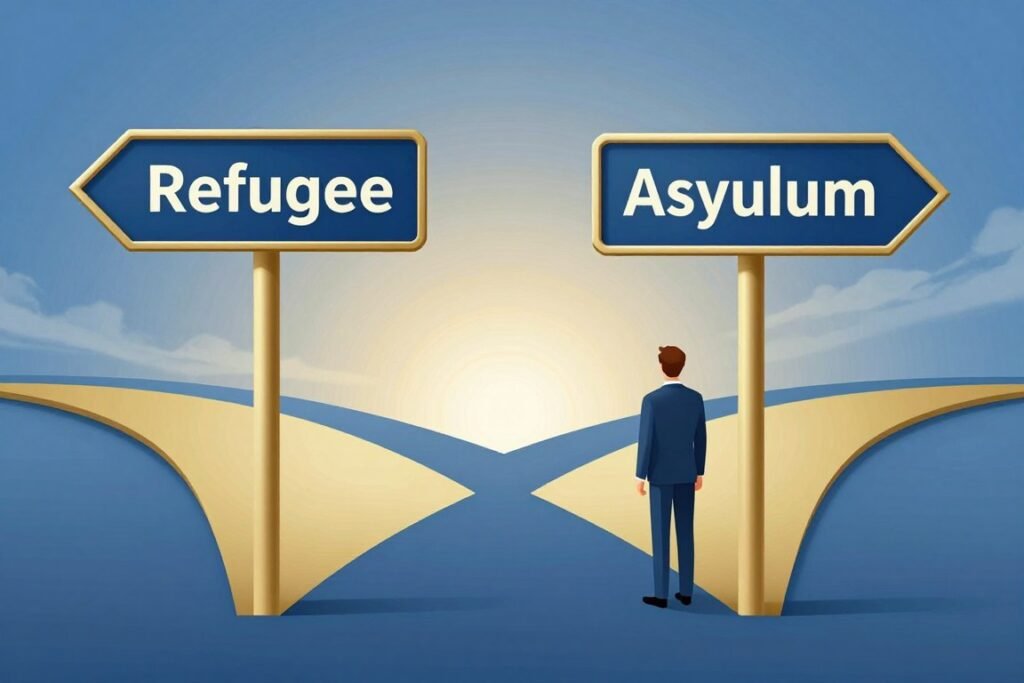
Deciding between refugee and asylum pathways depends on your current location and circumstances. Your physical location often determines which option is available.
When Refugee Status Is Your Only Option
You must pursue refugee status if you are currently outside the United States. Asylum is not available unless you can reach U.S. territory.
Refugee resettlement offers structured support. Organizations help with housing, employment, and cultural adjustment from day one.
However, you cannot choose refugee status if you are already in the United States. The location requirement is absolute.
When Asylum Status Is Appropriate
Asylum becomes your pathway if you reached the United States or a U.S. port of entry. You must apply within one year unless exceptions apply.
Asylum seekers have more control over their applications. You can gather evidence, select attorneys, and prepare your case while in the country.
The process requires persistence. Asylum cases take years, and you must navigate the system largely independently.
Factors to Consider in Your Decision
Several practical factors affect which status works better for your situation:
- Your current physical location determines which pathway is legally available
- Family members’ locations may influence whether you can apply together
- Urgency of your situation affects whether you can wait for refugee processing
- Available support networks in potential U.S. destinations
- Your ability to document persecution claims from your current location
- Financial resources for surviving during asylum processing periods
Understanding the refugee vs asylum status differences helps you make informed decisions about your protection strategy. Both pathways offer safety, but the processes differ significantly.
Conclusion: Your Journey to Safety Begins With Informed Action
The difference between refugee and asylum status comes down to location and process. Refugees apply from outside the United States through resettlement programs. Asylum seekers apply from within U.S. territory or at borders.
Both pathways protect individuals facing persecution based on race, religion, nationality, political opinion, or membership in a particular social group. Both lead to work authorization, green cards, and eventually citizenship.
The application processes differ substantially. Refugee status involves international agencies and takes 18 to 24 months. Asylum applications can take years but offer more direct control over your case.
Success requires understanding eligibility requirements, avoiding common mistakes, and preparing thoroughly. The stakes are high. Errors can result in denial and potential removal from the United States.
Whether you pursue refugee status or asylum, professional guidance significantly improves your chances. Immigration law is complex and constantly changing.
Take action now to protect yourself and your family. The sooner you begin the process, the sooner you can achieve safety and stability in the United States.
Frequently Asked Questions About Refugee and Asylum Status

Can I apply for both refugee and asylum status at the same time?
No, you cannot apply for both simultaneously because they are mutually exclusive based on location. If you are outside the United States, you must apply for refugee status. If you are already in the United States, you must apply for asylum. Your physical location determines which protection pathway is available to you.
What happens if I miss the one-year deadline for asylum?
Missing the one-year asylum filing deadline can bar your application unless you qualify for an exception. Valid exceptions include changed circumstances materially affecting your eligibility or extraordinary circumstances that prevented timely filing. Examples include serious illness, mental disability, ineffective legal representation, or significant changes in country conditions. You must demonstrate why the exception applies to your specific situation.
Can my family members come with me under refugee or asylum status?
Yes, but the process differs between pathways. Refugees can include their spouse and unmarried children under 21 in their initial application. These family members undergo the same screening process and travel together. Asylees must first receive approval, then petition to bring their spouse and unmarried children under 21 through a separate Form I-730 petition. Family members cannot accompany you in the initial asylum application.
How long can I stay in the United States with refugee or asylum status?
Both refugee and asylum status are granted indefinitely, meaning they do not expire. However, the government can terminate your status if country conditions change significantly, you voluntarily return to your home country, or you obtain citizenship from another country. After one year, you can apply for a green card to become a lawful permanent resident. Five years after receiving your green card, you become eligible to apply for U.S. citizenship.
Can I travel outside the United States with refugee or asylum status?
You can travel outside the United States, but you must obtain a Refugee Travel Document before leaving. This document allows you to return to the United States. However, traveling to your home country can raise serious questions about whether you truly fear persecution there. Such travel may result in termination of your refugee or asylum status. Always consult with an immigration attorney before planning international travel.
What is the difference between an asylee and a refugee in terms of benefits?
Refugees and asylees receive very similar benefits once granted status. Both can work immediately, apply for a green card after one year, and eventually pursue citizenship. The main difference is initial support. Refugees receive resettlement assistance including housing help, employment services, and cultural orientation through resettlement agencies. Asylees typically do not receive this structured support unless they access community organizations independently. Both can access certain federal benefits after meeting eligibility requirements.