
When Will Tax Refunds Arrive in 2026? Latest Timeline Explained
Millions of taxpayers across the United States eagerly wait for their tax refunds each year. The money represents a significant financial boost for families and individuals.
Understanding when your tax refund 2026 will arrive helps you plan major purchases and expenses. The IRS processes over 160 million tax returns during filing season.
This guide breaks down the exact timeline for 2026 tax refunds. You will learn how to get your money faster and avoid common delays.
What Tax Refunds Mean for Your Money
A tax refund happens when you pay more income tax throughout the year than you actually owe. The IRS returns the excess amount after you file your tax return.
Most workers have taxes withheld from each paycheck. Employers send this money to the government on your behalf.
Key Tax Terms Every Taxpayer Should Know
Tax withholding is the amount your employer takes from your pay. This goes toward your annual tax obligation.
Your tax return is the form you submit to the IRS. It calculates your actual tax liability for the year.
A tax refund is the difference when withholding exceeds your tax bill. The average tax refund in recent years has been around three thousand dollars.
How Withholding Works
Your employer calculates withholding based on your W-4 form. The form includes information about dependents and filing status.
- Paycheck deductions happen automatically
- Amounts vary based on income level
- You can adjust withholding anytime
- Changes affect future paychecks only
When Refunds Occur
Refunds result from several common situations. Understanding these helps you plan for next year.
- Claiming tax credits like child tax credit
- Deducting more than standard amount
- Having too much withheld from pay
- Receiving certain tax benefits
Average Refund Amounts
The average tax refund varies by taxpayer situation. Income level and credits claimed make big differences.
- National average around three thousand dollars
- Families with children often get more
- Single filers typically receive less
- Self-employed may owe instead
Refund vs. Tax Bill
Not everyone receives a refund each year. Some taxpayers owe additional money instead.
- Underpayment results in tax bills
- Freelancers often owe taxes
- Investment income changes liability
- Life changes affect withholding needs
Simple Example of Tax Refund Calculation
Consider a taxpayer who earned fifty thousand dollars in 2025. Their employer withheld six thousand dollars throughout the year.
After filing their return, their actual tax liability is four thousand five hundred dollars. The taxpayer receives a refund of one thousand five hundred dollars.
Important: The average refund for 2026 filing season is expected to remain steady compared to previous years. Economic factors and tax law changes can influence these amounts.
Current Tax Refund Rules for 2026 Filing Season
The IRS officially opened the 2026 filing season on January 27, 2026. Taxpayers can now submit returns for income earned in 2025.
The filing deadline falls on April 15, 2026. This date applies to most individual income tax returns.
E-Filing vs. Paper Filing Speed Differences
Electronic filing delivers refunds much faster than paper returns. The IRS strongly recommends e-filing for all taxpayers.
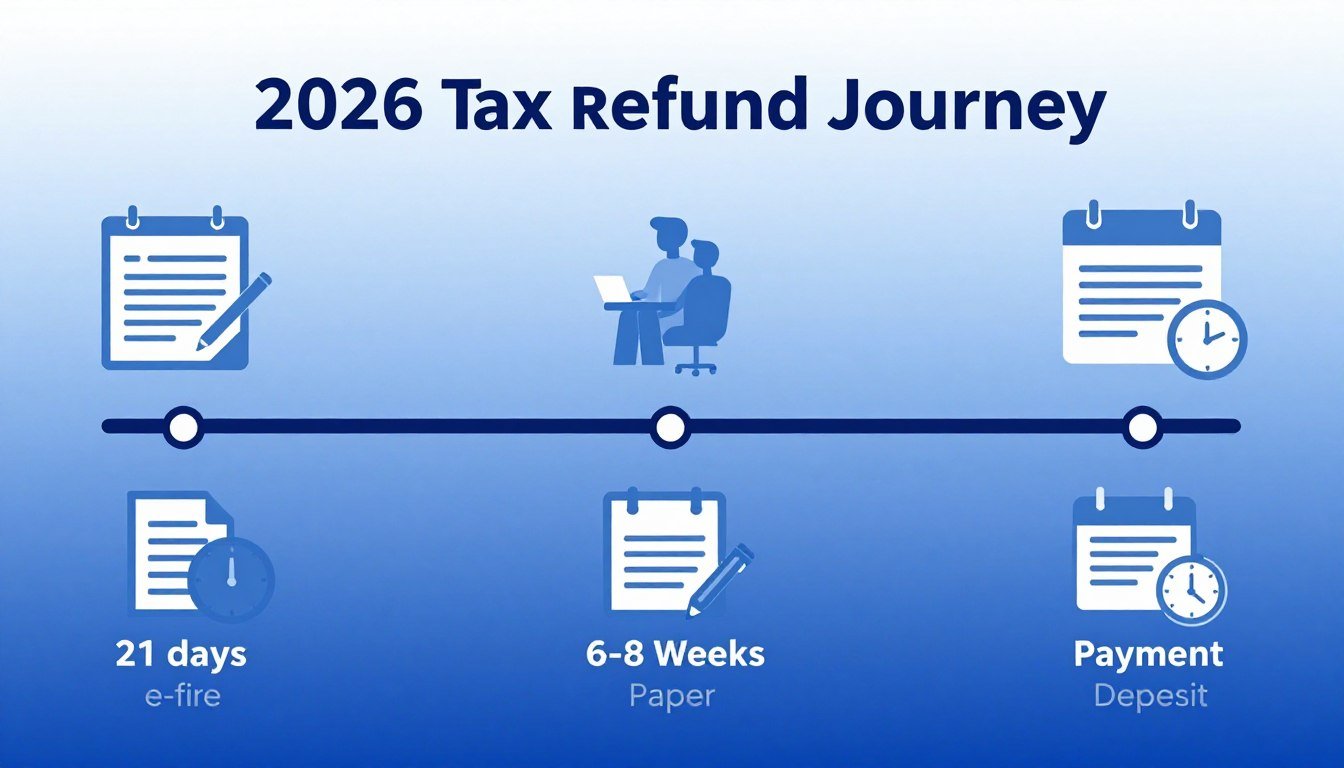
E-filed returns with direct deposit typically process within 21 days. This timeline starts from the date the IRS accepts your return.
Paper returns take significantly longer to process. Expect six to eight weeks for paper filing with direct deposit.
| Filing Method | Deposit Method | Processing Time | Recommended |
| E-File | Direct Deposit | 21 days | Yes |
| E-File | Paper Check | 4 weeks | No |
| Paper Mail | Direct Deposit | 6-8 weeks | No |
| Paper Mail | Paper Check | 8-10 weeks | No |
Direct Deposit vs. Paper Check Timeline
Direct deposit is the fastest way to receive your refund. The money goes straight into your bank account.
Paper checks add one to two weeks to your refund timeline. The IRS must print and mail physical checks.
You provide bank information on your tax return for direct deposit. Make sure account and routing numbers are correct.
New for 2026: The IRS has implemented new direct deposit verification procedures. Double-check your bank account number and routing number before submitting your return to avoid delays.
Factors That Affect Your Refund Processing Speed
Several factors influence how quickly the IRS processes your return. Understanding these helps set realistic expectations.
- Returns claiming Earned Income Tax Credit face additional review
- Child tax credit claims require extra verification
- Amended returns always take longer to process
- Incomplete or incorrect information causes delays
- Identity verification requests extend timelines
Who Benefits Most from Tax Refunds in 2026

Different groups of taxpayers benefit from refunds in various ways. Your personal situation determines refund size and timing importance.
Individual Taxpayers and Wage Earners
Single filers and individual workers represent the largest group. Most receive refunds due to standard withholding practices.
Workers with one employer typically have consistent withholding. This makes refund amounts more predictable year to year.
People who work overtime may receive larger refunds. Overtime pay often has higher withholding rates.
Families with Children
Families benefit significantly from the child tax credit. This credit can be worth up to two thousand dollars per qualifying child.
The average refund for families claiming child tax credit exceeds four thousand dollars. Credits reduce tax liability dollar for dollar.
Additional Child Tax Credit makes part of the credit refundable. Families can receive money even with zero tax liability.
Small Business Owners and Self-Employed
Small business owners have different refund patterns than employees. Many make quarterly estimated tax payments instead of withholding.
Overpayment of estimated taxes results in refunds. Business deductions and credits can increase refund amounts.
Self-employed taxpayers should track business expenses carefully. Proper documentation maximizes deductions and potential refunds.
Investors and Retirees
People with investment income may have tax withheld at source. Excess withholding on dividends and interest creates refunds.
Retirees receiving Social Security benefits sometimes get refunds. This happens when withholding exceeds actual tax liability.
Required minimum distributions from retirement accounts include withholding. Careful planning prevents over-withholding.
Common Mistakes That Delay Tax Refunds
Avoiding common errors ensures faster refund processing. The IRS identifies these mistakes as top causes of delays.
Incorrect Bank Account Information
Wrong account or routing numbers prevent direct deposit. The IRS cannot deposit funds into incorrect accounts.
Your refund gets returned to the IRS when bank information is wrong. The agency then mails a paper check instead.
This mistake adds three to four weeks to your refund timeline. Always verify bank account number and routing number before filing.
Warning: Transposed digits in account numbers are the most common error. Have your bank statement in hand when entering direct deposit information.
Not Checking Your Refund Status
Many taxpayers file and forget about their return. Checking status helps identify problems early.
The Where’s My Refund tool updates daily. You can spot issues that need attention.
Identity verification requests appear in the status tool. Responding quickly prevents extended delays.
Filing Too Early Without Complete Information
Some taxpayers rush to file before receiving all tax documents. Missing forms cause problems later.
Wait until you receive all W-2 forms from employers. Companies must send these by January 31.
Investment accounts send 1099 forms by mid-February. Filing before receiving these requires amended returns.
Math Errors and Calculation Mistakes
Manual calculations lead to errors on tax returns. The IRS must correct these before processing refunds.
Tax software automatically calculates amounts for you. This eliminates most math mistakes.
Common calculation errors include incorrect standard deduction amounts. They also involve wrong tax bracket calculations.
Choosing Paper Checks Over Direct Deposit
Paper checks take significantly longer to arrive than direct deposits. The IRS must print and mail physical checks.
Mailed checks can get lost or stolen. Direct deposit eliminates these risks.
You need a bank account for direct deposit. Prepaid debit cards also work for many taxpayers.
- Verify all Social Security numbers match official documents exactly
- Choose the correct filing status based on your situation
- Sign and date your return before submitting
- Include all required schedules and forms
- Keep copies of everything you submit
- Respond immediately to any IRS correspondence
- Use the same name that appears on your Social Security card
Tips to Get Your Tax Refund Faster in 2026
Smart strategies can significantly reduce your refund wait time. Following these tips puts money in your account sooner.
File Electronically With Direct Deposit
E-filing with direct deposit is the fastest combination possible. This method delivers refunds in as little as 21 days.
The IRS accepts e-filed returns immediately. Automated systems process them faster than paper returns.
Choose direct deposit during the filing process. Enter your bank account and routing number carefully.
File Your Return Early in the Filing Season
Early filers often receive refunds faster than late filers. The IRS processes fewer returns early in the season.
Filing in late January or early February is optimal. You avoid the mid-April rush completely.
Gather all tax documents before filing. Wait for all W-2 and 1099 forms to arrive.
Use IRS Free File or Tax Software
Tax preparation software reduces errors significantly. Built-in error checking catches mistakes before filing.
The IRS Free File program offers free tax software. Taxpayers earning under seventy-nine thousand dollars qualify.
Software guides you through deductions and credits. You might discover tax benefits you would otherwise miss.
Avoid Common Filing Errors
Error-free returns process much faster than returns with mistakes. The IRS must manually review returns with errors.
Triple-check Social Security numbers for yourself and dependents. One wrong digit causes processing delays.
Verify your filing status is correct. Married filing jointly differs from married filing separately.
Respond Quickly to IRS Requests
The IRS sometimes needs additional information to process returns. Quick responses prevent extended delays.
Identity verification requests require immediate attention. Follow instructions in IRS letters exactly.
Missing documentation requests should be answered within 30 days. Provide exactly what the IRS asks for.
Pro Tip: Set up IRS online account access before filing season. This gives you secure access to tax information and faster resolution of any issues.
Real Example: Typical Tax Refund Timeline
Understanding a real scenario helps set accurate expectations. This example shows typical timeline for most taxpayers.
Sample Taxpayer Situation
Sarah is a single taxpayer who earned fifty-five thousand dollars in 2025. Her employer withheld six thousand two hundred dollars throughout the year.
She has no dependents and takes the standard deduction. Her tax situation is straightforward with only W-2 income.
Filing and Processing Timeline
Sarah e-filed her return on January 30, 2026. She chose direct deposit to her checking account.
The IRS accepted her return on January 31, 2026. The acceptance notification arrived via email within 24 hours.
Her return moved to “Refund Approved” status on February 15, 2026. This happened exactly 15 days after IRS acceptance.
The direct deposit hit her bank account on February 18, 2026. Total time from filing to deposit was 19 days.
Refund Calculation Breakdown
Sarah’s taxable income after standard deduction was forty-one thousand four hundred dollars. Her tax liability calculated to four thousand nine hundred dollars.
Total withholding of six thousand two hundred dollars exceeded her tax liability. She received a refund of one thousand three hundred dollars.
| Item | Amount |
| Total Income | $55,000 |
| Standard Deduction (Single) | $13,600 |
| Taxable Income | $41,400 |
| Tax Liability | $4,900 |
| Total Withholding | $6,200 |
| Refund Amount | $1,300 |
This timeline represents optimal conditions for fastest refunds. E-filing with direct deposit and error-free returns produce similar results.
Future Tax Changes Affecting Refunds
Tax laws change regularly and affect future refund amounts. Understanding upcoming changes helps with planning.
Tax Cuts and Jobs Act Expiration
Many provisions from the 2017 tax cuts expire after 2025. This affects tax year 2026 and beyond.
Standard deduction amounts may change in future years. Tax brackets could also adjust differently.
The child tax credit faces potential modifications. Current credit amount might increase or decrease.
Inflation Adjustments for Tax Brackets
The IRS adjusts tax brackets annually for inflation. These changes affect how much tax you owe.
Bracket adjustments typically benefit taxpayers with wage increases. You might pay less tax on the same real income.
Standard deduction amounts also adjust for inflation each year. Higher deductions reduce taxable income.
Proposed Changes to Overtime and Tip Taxation
Recent proposals suggest eliminating tax on overtime pay. This would change withholding patterns significantly.
Tax cuts on tips have been discussed for service workers. Implementation would affect refund calculations.
These changes remain proposals as of early 2026. Follow IRS announcements for official updates.
Planning Ahead: Major tax law changes typically include transition rules. The IRS publishes guidance well before implementation to help taxpayers adjust.
Plan Ahead for Your 2026 Tax Refund
Tax refund timing depends heavily on how and when you file. E-filing with direct deposit delivers money in about three weeks.
The 2026 filing season runs from late January through mid-April. Early filers typically receive refunds faster than those who wait.
Avoiding common mistakes prevents delays and frustration. Double-check bank information and Social Security numbers before submitting.
Most taxpayers can expect refunds similar to previous years. The average tax refund remains around three thousand dollars for 2026.
Track your refund status using the IRS Where’s My Refund tool. Updates appear 24 hours after e-filing or four weeks after mailing.
Understanding the tax refund process puts you in control. File early, file electronically, and choose direct deposit for fastest results.
Changes to tax law may affect future filing season refunds. Stay informed about tax cuts and credit modifications that could impact you.
Start gathering your tax documents now if you have not already. The sooner you file an accurate return, the sooner you receive your refund.