
Trump Tariffs and Trade Statements: A Comprehensive Analysis of Impact and Legacy
President Donald Trump’s administration marked a significant shift in U.S. trade policy, embracing tariffs as a central tool in international economic relations. His “America First” approach represented one of the most dramatic departures from traditional U.S. trade policy in decades, with far-reaching consequences for domestic industries, international relations, and global trade patterns. This analysis examines the key tariff initiatives, their stated rationales, measurable impacts, and lasting influence on U.S. trade policy.
The “America First” Trade Philosophy
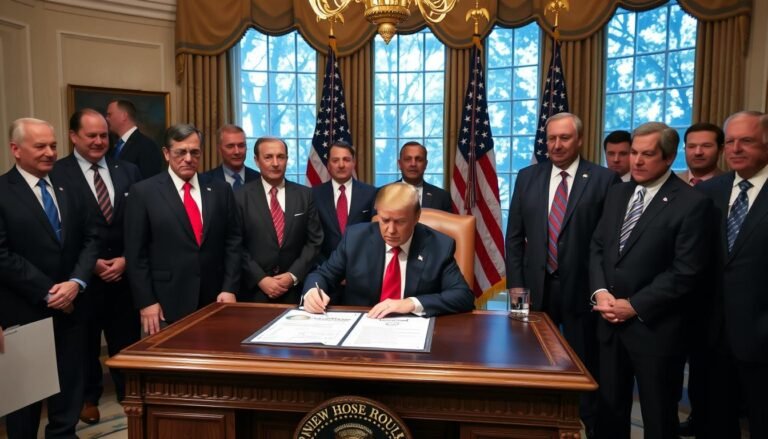
President Trump signing a trade executive order, emphasizing his “America First” approach to international commerce.
According to President Trump, “Tariff is the most beautiful word in the dictionary.” This statement encapsulates his administration’s unique approach to trade policy, which departed significantly from decades of U.S. support for trade liberalization. The Trump administration viewed tariffs not merely as protective measures for domestic industries but as powerful negotiating tools to address what it perceived as unfair trade practices by other countries.
The “America First” trade doctrine rested on several key principles: reducing trade deficits, protecting American manufacturing jobs, pressuring trading partners to negotiate more favorable terms, and using economic leverage to advance broader foreign policy goals. This approach represented a fundamental shift from the bipartisan consensus that had guided U.S. trade policy since World War II, which generally favored reducing trade barriers and strengthening multilateral institutions like the World Trade Organization.
Key Objectives of Trump’s Trade Policy
Section 232 Tariffs: Steel and Aluminum

In March 2018, the Trump administration imposed tariffs of 25% on steel imports and 10% on aluminum imports using Section 232 of the Trade Expansion Act of 1962, which authorizes trade restrictions when imports threaten national security. This marked one of the first major tariff actions of the administration and set the tone for its aggressive approach to trade policy.
National Security Rationale
The Trump administration justified these tariffs by arguing that dependence on imported metals weakened America’s industrial base and therefore its national security. “Steel is steel. You don’t have steel, you don’t have a country,” Trump stated when announcing the measures. The Department of Commerce’s investigation concluded that the declining market share of American steel and aluminum producers impaired national security by undermining the domestic capacity to produce materials essential for military equipment and critical infrastructure.
Implementation and Exemptions
Initially, temporary exemptions were granted to several countries, including Canada, Mexico, and the European Union. However, by June 2018, these exemptions were revoked, triggering retaliatory tariffs from affected trading partners. Later, some countries negotiated alternative arrangements, such as quotas or other trade concessions, to secure exemptions.
“Without steel and aluminum, our country is not the same. And we need it. We need it even for defense. We need it for defense.” — President Donald Trump, March 2018
Impact on Domestic Steel and Aluminum Industries
Positive Effects
- U.S. steel production increased by approximately 8% in 2018
- Steel industry added approximately 3,000 jobs
- Domestic steel prices initially rose, improving profitability for U.S. producers
- Several idled facilities reopened or increased production
Negative Effects
- Higher input costs for downstream manufacturers
- Studies estimated 15-45 jobs lost in steel-using industries for every job created in steel production
- Price volatility created planning challenges for businesses
- Retaliatory tariffs affected U.S. exporters in other sectors
Section 301 Tariffs: The China Trade War

The most significant and far-reaching tariff actions of the Trump administration targeted China. Beginning in 2018, the administration imposed a series of tariffs on Chinese imports under Section 301 of the Trade Act of 1974, which authorizes the U.S. Trade Representative to take action against foreign trade practices deemed unfair or discriminatory.
Unfair Trade Practices Rationale
The administration’s Section 301 investigation concluded that China engaged in several unfair practices, including forced technology transfer, intellectual property theft, cyber intrusions into U.S. commercial networks, and state direction of investments to acquire U.S. technology. “We have a tremendous intellectual property theft situation going on,” Trump stated, estimating the cost to the U.S. economy at hundreds of billions of dollars annually.
Escalating Tariff Waves
| Date | Tariff Rate | Products Affected | Value of Imports |
| July 2018 | 25% | Industrial equipment, machinery, electronics | $34 billion |
| August 2018 | 25% | Semiconductors, plastics, vehicles | $16 billion |
| September 2018 | 10% (increased to 25% in May 2019) | Consumer goods, furniture, electronics | $200 billion |
| September 2019 | 15% (later reduced) | Clothing, footwear, electronics | $112 billion |
By the end of 2019, approximately two-thirds of all Chinese imports to the United States were subject to tariffs, with average tariff rates increasing from 3.1% in January 2018 to 21.0% by September 2019, according to data from the Peterson Institute for International Economics.
Chinese Retaliation and the Phase One Agreement
China responded with retaliatory tariffs on U.S. exports, particularly targeting agricultural products like soybeans, pork, and corn. This escalating trade war led to negotiations that culminated in the “Phase One” trade agreement signed in January 2020. Under this agreement, China committed to purchasing an additional $200 billion in U.S. goods and services over two years and to strengthen intellectual property protections. In exchange, the U.S. reduced some tariffs and suspended planned increases on others.
Stay Updated on U.S.-China Trade Developments
Receive quarterly analysis on evolving trade policies and their economic impacts. Our expert reports provide data-driven insights on tariff developments and their consequences for global markets.
Other Significant Tariff Actions

Section 201 Safeguard Tariffs
In January 2018, the administration imposed “safeguard” tariffs under Section 201 of the Trade Act of 1974 on imported solar panels (30%) and washing machines (20-50%). These tariffs were designed to protect domestic manufacturers from a surge in imports that the U.S. International Trade Commission determined had caused serious injury to the domestic industry.
NAFTA Renegotiation and USMCA
President Trump frequently criticized the North American Free Trade Agreement (NAFTA) as “the worst trade deal ever made” and threatened to withdraw from it unless it was renegotiated. After contentious negotiations, the United States-Mexico-Canada Agreement (USMCA) was signed in November 2018 and went into effect in July 2020. While maintaining most of NAFTA’s tariff-free trade, the USMCA included new provisions on digital trade, intellectual property, and labor standards, as well as higher regional content requirements for the automotive sector.
Threatened and Negotiated Tariffs
The Trump administration frequently used the threat of tariffs to advance both trade and non-trade objectives. Notable examples include:
- Threatened auto tariffs on the European Union, which led to trade negotiations
- Threatened tariffs on Mexican imports unless Mexico increased enforcement against migration, which resulted in new border security measures
- Tariff threats against India over market access issues, which led to ongoing trade discussions
- Removal of preferential trade status for Turkey and India under the Generalized System of Preferences
Economic Impact of Trump’s Tariff Policies
Impact on U.S. Consumers and Businesses
Multiple economic studies have attempted to quantify the effects of the Trump administration’s tariffs on the U.S. economy. While there is debate about the precise magnitude of these effects, several key impacts have been documented:
Intended Positive Outcomes
- Increased production and employment in some protected sectors, particularly primary metals
- Leverage to secure trade concessions from trading partners
- Raised awareness of intellectual property issues and forced technology transfer
- Initiated reassessment of supply chain vulnerabilities
- Generated approximately $80 billion in tariff revenue (2018-2020)
Documented Negative Effects
- Higher prices for consumers on tariffed goods
- Increased input costs for manufacturers using imported materials
- Retaliatory tariffs that harmed U.S. exporters, particularly farmers
- Market uncertainty affecting business investment decisions
- Administrative burden of tariff exclusion processes
Price Impacts and Tariff Incidence
Research from the Federal Reserve, University of Chicago, and other institutions found that the cost of tariffs was largely passed on to U.S. consumers and businesses. A study by economists at the Federal Reserve Bank of New York, Princeton, and Columbia University estimated that the tariffs cost the average American household approximately $831 annually by the end of 2019.
“Contrary to the view that foreign exporters bear the incidence of U.S. import tariffs, we find that the U.S. tariffs were almost completely passed through into U.S. domestic prices.” — Federal Reserve study, December 2019
Sectoral Impacts
Manufacturing
Mixed effects, with some protected sectors seeing gains while others faced higher input costs. Studies from the Federal Reserve found that the net effect on manufacturing employment was negative, with job losses in tariff-using industries outweighing gains in protected sectors.
Agriculture
Significantly impacted by retaliatory tariffs, particularly from China. U.S. agricultural exports to China fell from $19.5 billion in 2017 to $9.1 billion in 2018. The administration provided approximately $28 billion in aid to affected farmers through the Market Facilitation Program.
Retail
Faced higher costs for imported consumer goods, particularly from China. Many retailers absorbed some costs to maintain competitive pricing, resulting in reduced profit margins. Some accelerated efforts to diversify supply chains away from China.
Macroeconomic Effects
The Congressional Budget Office and various economic studies estimated that the tariffs reduced U.S. GDP by 0.3-0.5% and eliminated approximately 300,000 jobs by the end of 2019. However, these effects were partially obscured by other economic factors, including fiscal stimulus from tax cuts and increased government spending during the same period.
Geopolitical and Strategic Consequences

U.S.-China Relations
The tariff war with China was part of a broader strategic reorientation of U.S.-China relations. The Trump administration’s 2017 National Security Strategy explicitly identified China as a “strategic competitor” and economic rival. The tariffs, combined with other measures like export controls on technology and restrictions on Chinese investment in the U.S., marked the beginning of what many analysts describe as a “decoupling” of the world’s two largest economies.
Global Supply Chain Restructuring
The tariffs accelerated changes in global supply chains that were already underway due to rising Chinese labor costs and technological changes. Many companies began diversifying their manufacturing away from China to countries like Vietnam, Mexico, and India. This trend, sometimes called “China+1,” has continued beyond the Trump administration as companies seek to reduce concentration risk in their supply chains.
Impact on the Multilateral Trading System
The Trump administration’s unilateral tariff actions and its blocking of appointments to the WTO’s Appellate Body created significant strains on the multilateral trading system. The administration argued that the WTO had failed to address unfair trade practices, particularly by China, and that unilateral action was necessary. Critics contended that undermining the rules-based trading system would have long-term negative consequences for global economic cooperation.
“When the United States is being treated unfairly, we will respond, whether that’s with tariffs or by enforcing our trade laws to ensure that trade is fair for American workers and businesses.” — U.S. Trade Representative Robert Lighthizer, 2019
Legacy and Current Relevance of Trump’s Tariff Policies

Continuity Under the Biden Administration
Despite campaign criticism of Trump’s tariff policies, the Biden administration has maintained most of the tariffs implemented by its predecessor. The Section 232 steel and aluminum tariffs remain largely in place, though with some modifications through agreements with the EU and other trading partners. Similarly, most of the Section 301 tariffs on Chinese goods have been preserved, with the administration conducting a statutory review rather than immediately removing them.
This continuity reflects several factors: the political sensitivity of removing protections for domestic industries, the leverage that tariffs provide in ongoing negotiations, and a bipartisan shift toward a more assertive stance on trade, particularly regarding China.
Reshaping the Trade Policy Debate
The Trump administration’s tariff policies have fundamentally altered the U.S. trade policy debate. Prior to 2017, there was a broad bipartisan consensus favoring trade liberalization and multilateral approaches. The aggressive use of tariffs as both protective measures and negotiating tools has now become a more accepted part of the policy toolkit, with debates focusing on how and when to use tariffs rather than whether to use them at all.
Lessons for Future Trade Policy
Did tariffs achieve their stated goals of revitalizing U.S. manufacturing?
The evidence is mixed. While some protected sectors saw modest employment gains, these were often offset by job losses in industries that use tariffed inputs. The manufacturing sector as a whole did not experience the renaissance that was promised, though certain segments benefited from increased protection.
Were tariffs effective as negotiating tools?
Tariffs did provide leverage in trade negotiations, leading to agreements like the USMCA and the Phase One deal with China. However, many of the concessions obtained were modest relative to the economic costs imposed, and some commitments (like China’s purchasing targets) were not fully met.
What are the long-term implications for U.S. trade policy?
The Trump administration’s tariff policies have established a precedent for more aggressive use of trade remedies and unilateral action. Future administrations now have expanded models for using tariffs not just as protective measures but as tools to advance broader economic and foreign policy objectives.

Statistical Overview of Trump’s Tariff Actions

Tariff Coverage and Rates
| Measure | Pre-Trump (2016) | Peak Trump Era (2019) | Change |
| Average U.S. Tariff Rate | 1.6% | 13.1% | +11.5 percentage points |
| Share of Imports Subject to Tariffs | 31.5% | 66.9% | +35.4 percentage points |
| Annual Tariff Revenue | $32.4 billion | $71.9 billion | +$39.5 billion |
| Average Tariff on Chinese Goods | 3.1% | 21.0% | +17.9 percentage points |
Trade Balance Outcomes
Despite the stated goal of reducing trade deficits, the U.S. goods trade deficit increased during the Trump administration, from $735 billion in 2016 to $864 billion in 2019. The bilateral deficit with China decreased temporarily due to reduced trade volumes, but deficits with other countries increased as importers sought alternative suppliers.
Key Trump Statements on Tariffs and Trade

Throughout his presidency, Donald Trump made numerous statements about tariffs and trade that revealed his thinking on these issues. These statements provide important context for understanding the administration’s policy choices.
“I am a Tariff Man. When people or countries come in to raid the great wealth of our Nation, I want them to pay for the privilege of doing so.”
“Trade wars are good, and easy to win.”
“The United States has been ripped off by other countries for years on Trade, time to get smart!”
“China has been taking out $500 billion a year out of our country and rebuilding China. I want our country to rebuild.”
“NAFTA is the worst trade deal maybe ever signed anywhere, but certainly ever signed in this country.”
“Tariffs will make our Country MUCH STRONGER, not weaker. Just sit back and watch!”
These statements reflect several consistent themes in Trump’s approach to trade: a belief that the U.S. had been disadvantaged by previous trade agreements, a view of trade as primarily zero-sum rather than mutually beneficial, a focus on bilateral trade deficits as measures of fairness, and confidence in tariffs as effective policy tools.
Conclusion: The Complex Legacy of Trump’s Tariff Policies

The Trump administration’s aggressive use of tariffs represented one of the most significant shifts in U.S. trade policy in decades. While the full impact of these policies continues to unfold, several conclusions can be drawn about their effects and legacy.
The tariffs achieved some of their stated objectives, particularly in providing protection to certain domestic industries and leverage in trade negotiations. However, they also imposed significant costs on U.S. consumers and businesses, disrupted global supply chains, and strained international economic relationships.
Perhaps the most lasting impact of the Trump tariff policies has been the fundamental shift in the U.S. trade policy debate. The bipartisan consensus favoring trade liberalization has given way to a more nuanced and sometimes skeptical approach to globalization. Concerns about supply chain resilience, industrial capacity, and economic security now feature prominently in trade discussions across the political spectrum.
As policymakers continue to navigate these complex issues, the Trump administration’s tariff policies will remain an important reference point—both for their immediate economic effects and for their role in reshaping how Americans think about trade and its relationship to national prosperity and security.
Explore Our Complete Trade Policy Analysis Series
Gain deeper insights into evolving U.S. trade policies and their implications for businesses, investors, and policymakers with our comprehensive analysis series.