Aging Population and Workforce Decline: How It Could Impact the U.S. Economy in 2026 and Beyond
The United States faces a demographic turning point that will reshape its economic landscape for generations. The aging population and workforce decline represent one of the most significant structural shifts in American economic history.
This isn’t a distant concern. The labor force participation rates among older workers have already begun shifting dramatically.
According to the Bureau of Labor Statistics, workers aged 65 and older now constitute over 7% of the total workforce. That number continues climbing each year. Meanwhile, the baby boomer generation’s retirement accelerates, removing experienced talent from businesses across every sector.
The Congressional Budget Office projects that by 2026, the U.S. labor force growth will slow to historic lows. Some years may see virtually zero net growth in the number of workers available.
This demographic reality creates cascading effects throughout the economy. From GDP growth rates to Social Security sustainability, the aging workforce touches every economic indicator Americans monitor.
Understanding these trends helps businesses plan staffing strategies. It guides policymakers in crafting economic responses. And it prepares individuals to navigate career and retirement decisions in a transformed labor market.
What Is This Economic Threat?
The aging population and workforce decline refers to a sustained decrease in labor force participation as the percentage of working-age adults shrinks relative to retirees. This demographic shift fundamentally alters the ratio of workers to non-workers in the economy.
At its core, the threat emerges from two converging trends. First, the baby boom generation born between 1946 and 1964 is reaching retirement age. Second, birth rates have fallen significantly over recent decades, producing fewer younger workers to replace those exiting the labor market.
The U.S. labor force grew rapidly throughout the 20th century. Immigration, rising female labor force participation, and the baby boom generation’s entry into working years all fueled expansion. Between 1950 and 2000, the labor force more than doubled.
That era has ended. The Bureau of Labor Statistics data shows labor force growth rates declining sharply since 2010. Population aging explains most of this slowdown.
Key Statistics Defining the Challenge
The numbers reveal the scale of demographic transformation ahead. Currently, approximately 10,000 baby boomers reach age 65 every day. This trend continues through 2030.
The labor force participation rate for prime-age workers has recovered somewhat since the pandemic. However, older workers face different dynamics. Many choose early retirement rather than navigating career transitions later in life.
Labor Force Participation Trends
The percentage of Americans actively working or seeking work has shifted dramatically across age groups over the past two decades.
- Overall labor force participation stands at 62.5% as of late 2023
- Workers aged 55-64 show 64.3% participation rates
- Those 65 and older maintain 18.6% participation
- Prime-age workers (25-54) demonstrate 83.5% participation
Demographic Projections Through 2030
Population aging accelerates through the remainder of this decade, fundamentally changing workforce composition.
- By 2030, all baby boomers will have reached age 65
- The 65+ population will grow to 73 million Americans
- Workers aged 55+ will comprise 25% of the labor force
- The working-age population growth slows to 0.2% annually
The Social Security Administration calculates that the worker-to-beneficiary ratio will decline from 2.8 workers per beneficiary in 2020 to 2.3 by 2035. This ratio stood at 5.1 workers per beneficiary in 1960.
These statistics matter because they represent structural economic shifts, not temporary business cycle fluctuations. The aging workforce represents a permanent new reality for the U.S. economy.
International comparisons provide context. Japan and several European nations already navigate more advanced population aging. Their experiences offer insights into challenges ahead for the United States.
What Is Causing the Problem?
Multiple factors converge to create workforce decline pressures. Understanding these causes helps clarify why the challenge proves so persistent and difficult to reverse quickly.
Policy Factors Shaping Demographics
Immigration policy significantly influences workforce size and age composition. The U.S. has historically relied on immigration to supplement domestic labor force growth.
- Restrictive immigration policies between 2017-2020 reduced legal immigration levels by approximately 49%
- Immigration flows traditionally skew younger, helping offset population aging
- Policy changes affect workforce projections years into the future as immigrants age through their careers
- The Congressional Budget Office estimates sustained immigration could add 0.2-0.3 percentage points to annual labor force growth
Retirement age policies also matter substantially. The Social Security full retirement age gradually increases from 65 to 67 for those born after 1960. However, many workers claim benefits at age 62, accepting permanently reduced monthly payments.
Tax policy influences retirement timing decisions. Required minimum distributions from retirement accounts, Social Security benefit taxation, and age-related tax provisions all affect when older workers exit the labor force.
Market Trends Driving Change
Economic conditions shape workforce participation patterns across all age groups. Labor market tightness, wage growth, and industry composition shifts all influence retirement timing and workforce engagement.
- Strong stock market performance through 2021 enabled earlier retirement for many workers with substantial 401(k) balances
- Housing wealth increases similarly funded early exits from the labor force
- Tight labor markets in 2022-2023 created opportunities for older workers to negotiate flexible arrangements
- Remote work adoption during the pandemic allowed some older employees to extend careers by eliminating commutes
- Healthcare cost increases create financial pressure to remain in employer-sponsored coverage until Medicare eligibility
Industry transformation plays a role as well. The shift from manufacturing to services affects older workers differently than younger cohorts. Physical demands of certain jobs make extended careers more challenging.
Automation and technological change create retraining requirements that some older workers find daunting. Knowledge obsolescence accelerates in rapidly evolving fields, sometimes pushing experienced workers toward retirement rather than skill updating.
Global Influences on U.S. Demographics
International trends affect U.S. workforce dynamics through several channels. Global competition for skilled workers intensifies as many developed nations face similar aging challenges.
- Other developed countries increasingly compete for the same immigrant talent pool
- Multinational corporations locate operations based partly on workforce availability
- Global supply chain disruptions highlight workforce constraints across trading partners
- International students who might join the U.S. workforce face visa restrictions and alternative opportunities in home countries
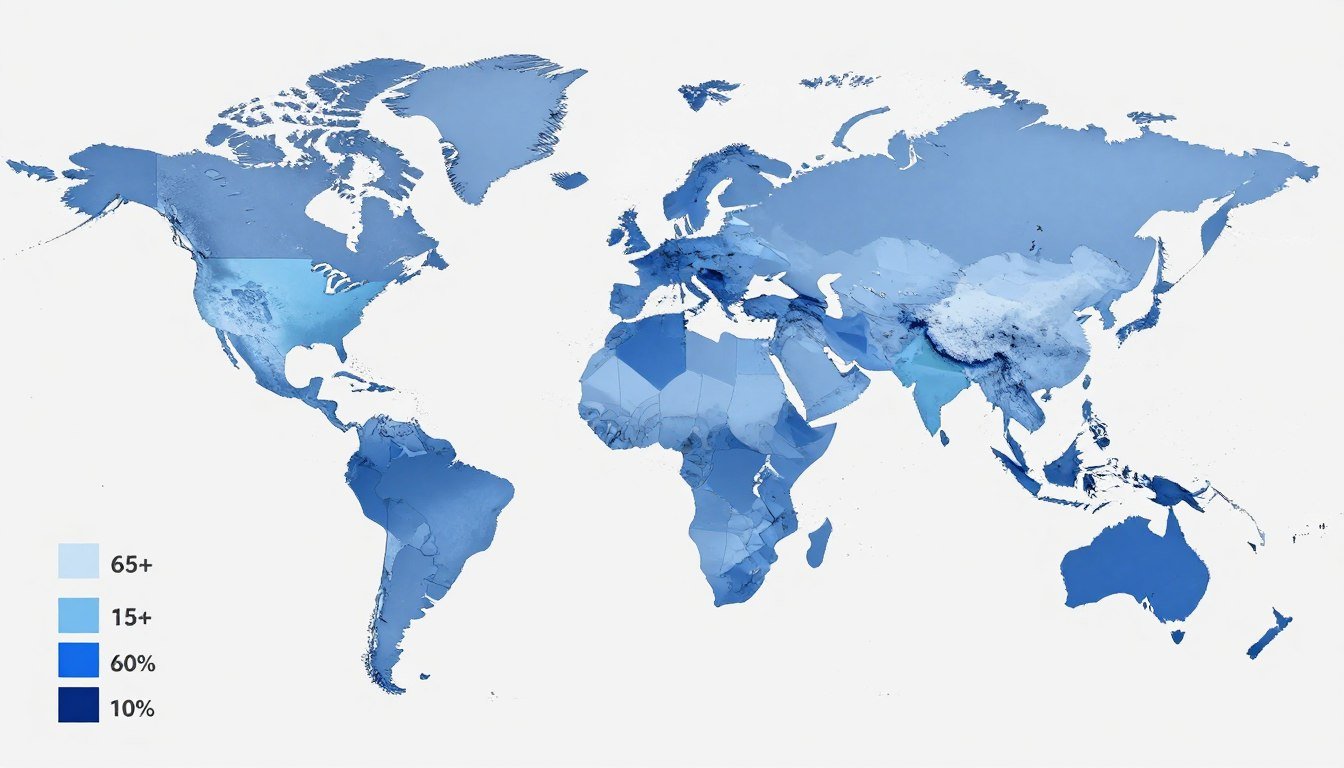
The World Bank data shows population aging as a global phenomenon. Japan leads with 29% of its population aged 65 or older. Germany stands at 22%. The U.S. currently reaches 17% but climbs toward 21% by 2030.
These global patterns mean solutions relying heavily on immigration face international competition. Countries worldwide seek younger workers to support aging populations.
Structural Economic Changes
Long-term structural shifts in the economy compound demographic pressures. The nature of work itself evolves in ways that affect older worker participation.
- Rising educational requirements for many jobs create barriers for workers whose formal education occurred decades ago
- Credential inflation makes experience-based advancement harder without additional degrees or certifications
- Gig economy growth provides flexibility but often lacks retirement benefits that encourage later career stability
- Healthcare tied to full-time employment creates reluctance to transition to part-time or consulting arrangements
- Age discrimination, though illegal, remains a documented factor in hiring and retention decisions
Productivity growth patterns also matter. Slower productivity gains mean more workers are needed to achieve the same economic output. The Bureau of Labor Statistics reports productivity growth averaged just 1.4% annually from 2007-2019, well below the 2.8% rate from 1995-2004.
Life expectancy trends create complexity. Americans live longer, suggesting longer careers might be feasible. However, healthy life expectancy doesn’t always match total life expectancy. Many workers face health limitations before reaching traditional retirement age.
Student debt burdens affect younger workers’ ability to save for retirement early. This may extend working years for future generations, but doesn’t address immediate labor force gaps as baby boomers retire.
Impact on the U.S. Economy
The economic consequences of workforce decline touch virtually every sector and metric. Understanding these impacts helps businesses and policymakers prepare for the transformed economic landscape.
GDP Growth Implications
Economic growth depends fundamentally on two factors: the number of workers and productivity per worker. When labor force growth slows dramatically, GDP growth faces headwinds unless productivity accelerates substantially.
The Congressional Budget Office projects potential GDP growth averaging just 1.8% annually from 2024 through 2034. This compares to 2.5% average growth from 1990 to 2020. The aging population accounts for most of this slowdown.
Labor force growth contributed approximately 0.5 percentage points to annual GDP growth historically. As this contribution falls toward zero or even negative territory, maintaining economic expansion becomes harder.
Per capita GDP growth matters more for living standards than total GDP. Even if overall economic growth slows, per capita measures could remain stable if the population ages without growing. However, supporting a larger retiree population still creates fiscal pressures.
Regional differences amplify national trends. Some states face more severe aging challenges than others. The Midwest and Northeast show particularly rapid population aging, while the South and West benefit from ongoing migration patterns.
Inflation Dynamics
The relationship between workforce decline and inflation operates through multiple channels. Tight labor markets can push wages higher, potentially feeding into broader price increases.
Between 2021 and 2023, labor shortages contributed to wage growth exceeding 5% annually for many job categories. Businesses facing worker scarcity bid up compensation to attract and retain employees. These labor cost increases often get passed to consumers through higher prices.
- Healthcare sector wages rose particularly sharply due to intense worker shortages among nurses and medical technicians
- Hospitality and food service industries offered unprecedented signing bonuses and wage increases to staff operations
- Transportation and logistics costs surged partly due to driver shortages exacerbated by older worker retirements
- Construction faces skilled trade worker gaps as experienced craftspeople retire faster than apprentices enter the workforce
However, the inflation impact isn’t uniformly upward. Older populations typically spend less than younger cohorts. Reduced aggregate demand from population aging can create disinflationary pressure in some sectors.
The Federal Reserve monitors these dynamics closely. The relationship between labor market tightness and inflation influences monetary policy decisions that affect interest rates throughout the economy.
Employment Landscape Transformation
Paradoxically, workforce decline creates both labor shortages and changing employment dynamics. The nature of work evolves as businesses adapt to demographic constraints.
Employers increasingly redesign jobs to accommodate older workers. Flexible scheduling, remote work options, and modified physical requirements help retain experienced employees. Some businesses create returnship programs to bring recent retirees back into the workforce part-time.
The job market for younger workers simultaneously faces unique pressures. With fewer entry-level candidates available, employers compete intensely for recent graduates. Starting salaries have risen sharply in many fields.
Automation adoption accelerates as businesses seek to maintain output with fewer workers. Technologies that seemed marginally cost-effective when labor was abundant become essential investments during worker shortages.
- Manufacturing increasingly deploys collaborative robots to augment human workers rather than fully replace them
- Retail adopts self-checkout and automated inventory systems to reduce cashier and stocker requirements
- Restaurants experiment with kitchen automation and digital ordering to operate with smaller staffs
- Healthcare invests in telemedicine and AI diagnostic tools to extend physician and nurse productivity
Skills gaps widen in critical areas. The retirement of experienced workers removes institutional knowledge that younger employees haven’t yet acquired. Knowledge transfer becomes a strategic priority for organizations.
Financial Markets Response
Capital markets react to demographic shifts through multiple channels. Asset prices, interest rates, and investment flows all adjust to new economic realities.
The International Monetary Fund research suggests population aging correlates with lower real interest rates. As the population ages, aggregate savings rates typically increase. More people save for retirement rather than borrow for homes and education. This excess savings supply pushes interest rates downward.
Lower interest rates affect asset valuations across categories. Stock prices reflect discounted future earnings streams. When discount rates fall, equity valuations rise, all else equal. This partly explains elevated price-to-earnings ratios in recent years.
Bond Market Adjustments
Fixed income markets adapt to demographic realities through yield curve changes and duration preferences.
- Older investors typically shift portfolios toward bonds, increasing fixed income demand
- Government borrowing to fund Social Security and Medicare rises, increasing bond supply
- The balance between these forces determines interest rate trajectories
Equity Market Implications
Stock markets face both headwinds and tailwinds from demographic change.
- Slower economic growth potentially reduces corporate earnings growth
- Labor cost pressures compress profit margins in labor-intensive industries
- Companies successfully automating or adapting may see competitive advantages
- Healthcare and senior-focused industries benefit from aging population spending
Real estate markets show divergent patterns. Housing demand shifts as preferences change with age. Younger families seek starter homes and family-sized properties. Older adults increasingly prefer accessible single-story homes or retirement communities.
Commercial real estate responds to changing labor force patterns. Remote work adoption, enabled partly to retain older workers, reduces office space demand. Conversely, healthcare facility demand grows with the aging population.
Consumer and Business Behavior Shifts
Spending patterns evolve as population composition changes. The aging workforce and growing retiree population redirect consumption toward different goods and services.
Healthcare spending rises substantially. Individuals aged 65 and older spend roughly three times more on healthcare than younger adults. As this demographic cohort grows, healthcare’s share of GDP expands from approximately 18% currently toward 20% by 2030.
- Prescription drug spending increases with age-related chronic conditions
- Long-term care services face surging demand as the 80+ population grows
- Medical device and equipment markets expand to serve aging consumers
- Home modification services grow as older adults age in place rather than move to facilities
Leisure and travel spending remains significant for healthy retirees. The travel industry adapts offerings for older consumers who have time flexibility but prefer different activities than younger travelers.
Business investment patterns adjust to demographic realities. Companies allocate capital differently when facing persistent worker shortages. Investment in labor-saving equipment and technology increases. Training programs expand to develop internal talent rather than relying on external hiring.
Small businesses face particular challenges. Resource constraints make it harder to compete for scarce workers. Some business owners find succession planning difficult when younger buyers aren’t available or interested.
Recent Data and Trends
Current statistics reveal the demographic transformation already underway. Recent data from government and institutional sources provides clarity on the pace and scope of workforce aging.
Bureau of Labor Statistics Workforce Data
The Bureau of Labor Statistics publishes detailed labor force statistics that track participation rates, employment levels, and demographic composition. The latest data shows clear acceleration of aging trends.
As of December 2023, the civilian labor force totaled 167.5 million people. The labor force participation rate stood at 62.5%, still below the 67.3% peak reached in early 2000. Much of this decline reflects population aging rather than discouragement.
| Age Group | Labor Force (millions) | Participation Rate | Change Since 2019 |
| 16-24 years | 21.8 | 55.4% | -1.2% |
| 25-54 years | 105.3 | 83.5% | +0.8% |
| 55-64 years | 27.4 | 64.3% | -1.8% |
| 65+ years | 11.0 | 18.6% | +0.9% |
These numbers reveal important patterns. Prime-age worker participation has largely recovered from pandemic disruptions. However, participation among workers aged 55-64 remains below pre-pandemic levels. Many took early retirement during the crisis and haven’t returned.
Workers aged 65 and older show resilient participation. Some delayed retirement due to financial necessity or increased work flexibility. However, the absolute number of older workers, while growing, can’t offset broader demographic trends.
Social Security Administration Projections
The Social Security Administration produces detailed demographic and financial projections examining program sustainability. These forecasts illuminate the scale of population aging impacts.
The 2023 Trustees Report projects the number of Social Security beneficiaries will increase from 67 million in 2022 to 80 million by 2033. This represents a 19% increase in just over a decade.
The covered worker-to-beneficiary ratio tells a compelling story. In 2022, the ratio stood at 2.8 covered workers per beneficiary. By 2040, this falls to 2.3 workers per beneficiary. The long-term sustainable ratio would be approximately 3.0 workers per beneficiary to maintain current benefit levels without tax increases.
Trust fund depletion dates capture attention. The combined Old-Age and Survivors Insurance and Disability Insurance trust funds face depletion by 2034 under current law and intermediate assumptions. At that point, incoming tax revenues would cover only 80% of scheduled benefits.
Congressional Budget Office Economic Outlook
The Congressional Budget Office provides non-partisan analysis of fiscal and economic trends. Their demographic projections incorporate multiple data sources to forecast labor force evolution.
The February 2024 Budget and Economic Outlook projects civilian labor force growth averaging just 0.3% annually from 2024 through 2034. This compares to 0.8% annual growth from 2000 to 2020 and 1.5% growth from 1980 to 2000.
- Immigration assumptions significantly influence these projections – higher immigration scenarios could add 0.1-0.2 percentage points to annual growth
- Labor force participation rate projections show continued decline, reaching 61.3% by 2034
- The share of the labor force aged 55 and older increases from 24.8% in 2023 to 26.3% by 2034
- Total employment growth slows to 0.4% annually, down from 1.0% historical average
Potential GDP growth projections reflect these workforce constraints. The CBO estimates potential output growth averaging 1.9% annually through 2034, with labor force growth contributing just 0.2 percentage points of that total.
Census Bureau Population Estimates
The U.S. Census Bureau tracks population changes and produces detailed demographic projections. Recent estimates show accelerating population aging across all regions.
The 2020 Census revealed the median age of the U.S. population increased to 38.8 years, up from 37.2 in 2010. This represents the largest decade-over-decade median age increase since census records began.
State-level data reveals geographic variation in aging patterns. Maine, Florida, West Virginia, and Vermont show the highest median ages, all exceeding 43 years. Utah, the District of Columbia, Texas, and Alaska show the youngest populations, with median ages below 36.
Birth rate data underscores the challenge’s persistence. The total fertility rate reached a record low of 1.64 births per woman in 2020. While it recovered slightly to 1.67 by 2022, this remains well below the replacement rate of 2.1 needed for population stability without immigration.
International Comparisons and Context
Global data provides perspective on how U.S. demographic trends compare internationally. The World Bank and International Monetary Fund track population aging worldwide.
The U.S. aging trajectory, while significant, remains less severe than many peer nations. Japan leads developed countries with 29.8% of the population aged 65 or older. Italy reaches 23.6%, Germany 22.1%, and France 21.1%. The U.S. stands at 17.0% currently.
| Country | Population 65+ (2023) | Projected 65+ (2040) | Old-Age Dependency Ratio |
| Japan | 29.8% | 35.3% | 51.9 |
| Germany | 22.1% | 28.8% | 35.7 |
| United Kingdom | 19.2% | 24.3% | 29.4 |
| United States | 17.0% | 21.6% | 27.9 |
| Canada | 18.8% | 24.0% | 28.1 |
The old-age dependency ratio measures people aged 65+ per 100 working-age adults (15-64). Higher ratios indicate greater economic burden on working populations. The U.S. ratio of 27.9 in 2023 will climb to approximately 37.0 by 2040.
These international comparisons matter because they show the U.S. faces challenges similar to other developed nations, though typically on a somewhat less severe timeline. Solutions other countries implement offer lessons for American policymakers.
Expert Opinions or Forecasts
Economists and policy analysts have examined demographic trends extensively. Their projections and assessments provide insight into likely economic trajectories and potential disruptions.
Federal Reserve Analysis and Policy Perspectives
Federal Reserve economists study demographic factors influencing monetary policy effectiveness and economic growth potential. Their research informs interest rate decisions and financial stability assessments.
Fed Chair Jerome Powell has addressed aging population impacts in multiple speeches. He noted in a 2023 address that labor force constraints from demographics represent “a structural economic shift that monetary policy cannot fundamentally change.”
Federal Reserve Bank research papers examine specific transmission mechanisms. A 2023 San Francisco Fed study found that population aging accounts for approximately 1.25 percentage points of the decline in the natural rate of interest since 1980. Lower neutral rates constrain monetary policy space during recessions.
The Congressional testimony from Fed officials consistently emphasizes immigration as a key variable. Vice Chair Philip Jefferson stated that “immigration flows substantially influence not just labor force size but also innovation and productivity growth trends.”
Treasury Department and Budget Office Projections
The U.S. Department of the Treasury focuses on fiscal implications of demographic change. Social Security, Medicare, and Medicaid spending all rise substantially as the population ages.
Treasury analysis projects that federal spending on major health programs and Social Security will increase from 10.6% of GDP in 2023 to 13.8% by 2040. This represents an additional $1.7 trillion in annual spending at current GDP levels.
- Medicare spending grows from 3.1% to 4.3% of GDP as enrollment expands from 65 million to 88 million beneficiaries
- Social Security outlays rise from 5.2% to 6.3% of GDP despite relatively modest benefit increases
- Medicaid long-term care spending surges as the 85+ population doubles by 2040
- Interest costs on federal debt compound the fiscal challenge as deficits accumulate
The Congressional Budget Office’s long-term budget outlook paints a stark picture. Under current law, federal debt held by the public rises from 99% of GDP in 2024 to 166% by 2054. Demographic pressures drive most of this increase through mandatory spending growth.
Private Sector Economic Forecasters
Major economic forecasting firms incorporate demographic factors into their outlook models. Their predictions guide business investment and strategic planning decisions.
Moody’s Analytics projects GDP growth averaging 1.9% annually from 2025 through 2030, with demographic headwinds subtracting approximately 0.3 percentage points from potential growth. Chief economist Mark Zandi notes that “absent substantial productivity acceleration or immigration increases, 2% growth represents a ceiling for the U.S. economy.”
Goldman Sachs Research
Goldman Sachs economists forecast labor force growth near zero through 2030, with participation rates declining to 61% by decade-end.
Their analysis suggests corporate profit margins face persistent pressure from tight labor markets. Companies in labor-intensive industries may see margin compression of 1-2 percentage points.
Goldman projects healthcare and technology sectors best positioned to navigate demographic shifts through automation and growing senior market demand.
J.P. Morgan Outlook
J.P. Morgan research emphasizes regional variation in demographic impacts. Sunbelt states benefit from ongoing migration, while Rust Belt regions face acute workforce challenges.
Their fixed income team expects demographic factors to keep real interest rates below historical averages, supporting higher asset valuations despite slower growth.
J.P. Morgan forecasts increased M&A activity as aging business owners seek succession solutions through sales rather than internal transitions.
Academic Research Perspectives
University economists study long-term demographic impacts using sophisticated models. Their work often examines policy alternatives and international comparisons.
Research from the National Bureau of Economic Research explores productivity implications. A 2023 study found that older workers maintain high productivity in knowledge-intensive roles but face physical limitations in manual occupations. Job redesign and accommodation investments yield strong returns.
Harvard economist David Cutler’s research on healthcare spending projects that demographic aging adds approximately $200 billion annually to national health expenditures by 2030. However, improved health among older Americans partially offsets this through delayed disability and reduced intensive care needs.
International Monetary Fund Global Assessment
The International Monetary Fund analyzes demographic trends worldwide, examining both developed and emerging economy experiences. Their research provides global context for U.S.-specific challenges.
IMF economists project that population aging in advanced economies reduces global GDP growth by 0.2-0.4 percentage points annually through 2040. Cross-border capital flows adjust as aging nations save more while younger emerging economies invest in growth.
The IMF’s World Economic Outlook consistently emphasizes policy responses. Successful adaptation strategies across countries share common elements: immigration openness, delayed retirement ages, productivity-enhancing investments, and fiscal sustainability measures.
Risk Assessment and Probability Scenarios
Evaluating the likelihood and severity of various demographic scenarios helps frame the economic threat level. Most experts assess the baseline aging scenario as virtually certain, with uncertainty centered on magnitude and policy responses.
The demographic trends themselves carry extremely high probability. Birth rates and immigration levels would need dramatic, sustained changes to alter the basic trajectory significantly. The baby boom generation’s retirement is already locked in.
Economic impact severity depends substantially on policy responses and productivity growth. Pessimistic scenarios with minimal adaptation see GDP growth falling below 1.5% annually, fiscal sustainability crises, and significant living standard pressures.
Optimistic scenarios featuring robust productivity growth, strategic immigration policy, and successful workforce adaptations maintain 2% or higher growth with manageable fiscal pressures. Most expert forecasts fall between these extremes.
The consensus view rates this as a medium-high risk economic challenge. The certainty of occurrence is nearly absolute. The severity depends on collective policy choices and economic adaptations over the coming decade.
Possible Solutions or Policy Responses
Addressing aging population and workforce decline challenges requires coordinated action across government, business, and society. No single solution suffices, but a comprehensive approach can mitigate economic impacts.
Government Policy Initiatives
Federal and state governments possess multiple policy levers to address demographic challenges. Immigration reform, retirement policy adjustments, education investments, and fiscal sustainability measures all play important roles.
Immigration Policy Reform
Immigration represents the most direct mechanism to increase labor force size and slow workforce aging. Immigrants tend to arrive during prime working years, immediately boosting labor supply.
- The Economic Policy Institute analysis suggests raising annual immigration to 1.2 million per year could restore labor force growth to 0.5% annually
- Skills-based immigration systems could target specific labor shortages in healthcare, technology, and skilled trades
- Streamlining visa processes for international students graduating from U.S. universities retains highly educated workers
- Regional visa programs could direct immigrants toward areas facing the most severe demographic challenges
Bipartisan immigration reform remains politically challenging despite economic benefits. Public opinion research shows majority support for increased legal immigration when framed around economic needs and skills.
Retirement Age and Social Security Adjustments
Gradually increasing the full retirement age for Social Security extends working years and improves program solvency. Most proposals phase increases slowly to minimize disruption.
Current law raises the full retirement age to 67 for those born in 1960 or later. Further increases to age 68 or 69, phased in over decades, appear in many reform proposals. Such changes could reduce Social Security’s 75-year funding gap by approximately one-third.
Incentivizing delayed retirement through enhanced benefits for later claiming can extend careers voluntarily. Currently, benefits increase 8% annually for each year of delayed claiming between full retirement age and age 70. Expanding this incentive could encourage longer work lives.
Eliminating the Social Security earnings test after full retirement age would remove disincentives for older workers to continue employment while receiving benefits. Current rules reduce benefits for those earning above certain thresholds before full retirement age.
Education and Workforce Development
Investing in education and training helps workers remain productive longer and adapt to technological change. Lifelong learning initiatives matter increasingly as careers span decades.
- Expanding community college and vocational training programs builds skills pipelines in critical shortage areas
- Tuition assistance and retraining grants help midcareer workers transition to growing fields
- Apprenticeship programs in skilled trades address gaps as experienced tradespeople retire
- Digital literacy initiatives prepare older workers for technology-intensive roles
The AIHR research emphasizes that companies benefit substantially from investing in older worker training. Return on investment often exceeds training for younger employees because older workers typically remain with employers longer after skill development.
Federal Reserve Monetary Policy Considerations
The Federal Reserve’s monetary policy toolkit operates somewhat differently in a demographically constrained economy. Central bankers must account for structural changes affecting labor markets and inflation dynamics.
Lower neutral interest rates from population aging mean the Fed has less room to cut rates during recessions. This increases importance of fiscal policy and unconventional monetary tools during downturns.
Labor market tightness from workforce decline may keep wage growth elevated even when unemployment rates rise. The Fed must distinguish between temporary inflation and demographic-driven structural wage pressure.
“Central banks worldwide must adapt frameworks to demographic realities. The relationship between unemployment and inflation evolves when labor force constraints become binding.”
Some economists advocate higher inflation targets to provide more monetary policy space. Raising the target from 2% to 3% would give the Fed additional room to cut real rates during recessions, though this remains controversial.
Market-Driven Business Adaptations
Private sector responses to labor scarcity drive significant adaptation even absent policy changes. Market forces compel businesses to innovate when traditional labor sources disappear.
Automation and Technology Investment
Labor shortages accelerate automation adoption across industries. Technologies that previously seemed cost-prohibitive become essential investments when workers aren’t available at any reasonable wage.
- Manufacturing deploys collaborative robots that work alongside human employees, augmenting rather than replacing workers
- Retail automates inventory management, checkout, and restocking functions to operate with smaller staffs
- Healthcare implements AI diagnostic tools, telemedicine platforms, and robotic surgery assistance to extend physician productivity
- Agriculture adopts autonomous equipment and precision farming technology to address agricultural worker shortages
- Transportation invests in autonomous vehicle development to address commercial driver shortages
Productivity gains from automation can partially offset slower labor force growth. However, the transition creates winners and losers. Workers whose skills complement new technologies thrive. Those in easily automated roles face displacement.
Workplace Flexibility and Accommodation
Employers redesign work arrangements to retain older employees and attract workers with caregiving responsibilities. Flexible policies expand the effective labor pool.
Remote work options eliminate commutes that become more burdensome with age. Many older workers willing to continue careers part-time prefer working from home. The pandemic proved remote work’s feasibility across many roles.
Retention Strategies
- Phased retirement programs allowing gradual work reduction before full exit
- Flexible scheduling accommodating medical appointments and reduced stamina
- Job redesign reducing physical demands of roles previously requiring strength or mobility
- Mentorship programs pairing experienced workers with newer employees for knowledge transfer
- Returnship initiatives bringing recent retirees back for project-based or seasonal work

Compensation and Benefits Innovation
Total compensation packages evolve to address different priorities across age groups. Older workers often value healthcare benefits and schedule flexibility over base salary increases. Younger workers prioritize student loan assistance and career development.
Healthcare cost containment matters particularly for retaining workers approaching Medicare eligibility. High-quality employer coverage bridges the gap from career end to Medicare access at age 65.
Some businesses offer “bonus years” programs. Workers who delay retirement beyond normal age receive enhanced benefits, additional vacation time, or special recognition. These programs acknowledge longer service while incentivizing continued employment.
Multi-Stakeholder Collaboration Models
The most effective responses combine government policy, business adaptation, and individual behavior changes. Collaborative frameworks coordinate actions across sectors.
Public-private partnerships address specific skill shortages. Industry groups work with educational institutions to design curricula matching employer needs. Government provides funding while businesses offer apprenticeships and hiring commitments.
Regional economic development organizations coordinate demographic responses at state and local levels. Some states create dedicated workforce agencies focused on older worker engagement and training.
What It Means for Americans
Demographic shifts affect everyday Americans through multiple channels. Understanding these practical implications helps individuals make informed decisions about careers, finances, and retirement planning.
Cost of Living Implications
Labor shortages influence prices across many goods and services. When businesses struggle to find workers, labor costs rise. These increases typically flow through to consumer prices.
Service sector prices show particular sensitivity to workforce constraints. Restaurants, healthcare facilities, childcare centers, and personal services all depend heavily on available workers. Tight labor markets push service prices higher.
Healthcare costs face particular upward pressure. Growing demand from aging baby boomers combines with healthcare worker shortages. Nurse and physician assistant shortages lead to higher wages, which providers pass through to insurance premiums and out-of-pocket costs.
Housing costs show regional variation based on demographic patterns. Areas attracting younger workers see strong housing demand and price appreciation. Regions losing population to out-migration face stagnant or declining home values.
- Healthcare spending for families rises approximately 4-5% annually, outpacing general inflation
- Childcare costs increase 3-4% yearly as centers struggle to staff positions at prevailing wages
- Restaurant and food service prices climb faster than grocery costs due to labor intensity
- Home repair and maintenance services become more expensive as skilled tradespeople retire
Job Market Opportunities and Career Considerations
Worker shortages create opportunities alongside challenges. Career paths, advancement prospects, and job security all look different in a tight labor market.
Young workers entering the labor force find abundant opportunities. Employers compete aggressively for entry-level talent, offering higher starting salaries than previous cohorts enjoyed. Career advancement accelerates when companies promote from within due to external hiring difficulties.
Mid-career professionals benefit from strong bargaining positions. The option to change employers provides leverage in salary negotiations with current employers. Remote work opportunities expand geographic options without requiring relocation.
Early Career (Age 22-35)
Entry-level workers face the strongest job market in decades with multiple advantages.
- Higher starting salaries across most industries
- Faster advancement as experienced workers retire
- Greater flexibility to switch employers and industries
- Increased remote work options providing lifestyle flexibility
Mid-Career (Age 35-55)
Established professionals leverage experience in tight labor markets for career optimization.
- Strong negotiating position for raises and promotions
- Opportunities to transition into leadership roles
- Ability to pursue entrepreneurship with lower failure risk
- Options for career pivots through retraining programs
Late Career (Age 55+)
Older workers find extended career opportunities previously unavailable to their cohort.
- Employers actively recruit and retain experienced workers
- Flexible work arrangements accommodate reduced hours
- Consulting and project-based roles extend careers past traditional retirement
- Delayed retirement improves financial security
However, automation risks loom for workers in routine roles. As labor costs rise, businesses accelerate automation investments. Workers must continuously update skills to remain relevant as technology evolves.
Geographic mobility matters more in tight labor markets. Workers willing to relocate to growing regions find the best opportunities. Remote work reduces this constraint for knowledge workers but matters less in location-dependent roles.
Investment and Retirement Planning Adjustments
Demographic trends affect investment returns and retirement security. Financial planning must account for these structural economic changes.
Lower economic growth from workforce decline potentially reduces stock market returns. Historical equity returns averaged 10% annually, but future returns may run 1-2 percentage points lower if GDP growth stays below 2%.
Bond yields reflect demographic pressures. Excess savings from aging populations keeps interest rates low, reducing income available to retirees from fixed-income investments. The traditional 60/40 stock-bond portfolio may need recalibration.
Social Security Timing Decisions
When to claim Social Security benefits becomes more complex given program sustainability concerns and individual longevity expectations.
- Delaying benefits until age 70 maximizes monthly payments but requires funding the gap years
- Claiming at full retirement age (67 for most current workers) balances benefit size and retirement timing
- Early claiming at 62 reduces monthly benefits by 30% but provides immediate income
- Program solvency concerns add uncertainty to long-term benefit projections
Healthcare costs in retirement require substantial savings. The Fidelity Retiree Health Care Cost Estimate projects a 65-year-old couple retiring in 2023 needs $315,000 to cover healthcare expenses throughout retirement. This figure rises annually.
Investment Sector Positioning
Certain sectors benefit disproportionately from population aging while others face headwinds. Strategic sector allocation matters for long-term returns.
- Healthcare services and facilities serving older patients
- Pharmaceutical companies focused on age-related conditions
- Medical device manufacturers for aging-related needs
- Senior housing and assisted living operators
- Healthcare REITs owning medical facilities
- Automation and robotics companies
- Home healthcare and services providers
Demographic Beneficiaries
- Labor-intensive manufacturing without automation
- Traditional retail requiring large staffs
- Hospitality and food service with tight margins
- Construction firms lacking skilled trade workers
- Entry-level consumer goods facing demand declines
- Commercial real estate in depopulating regions
- Industries resistant to technological change
Challenged Sectors
Housing Market Considerations
Real estate decisions require understanding demographic impacts on property values, rental demand, and regional growth patterns.
Older homeowners represent a large share of housing wealth. As baby boomers age, many will eventually sell homes or downsize. This could increase housing supply in certain markets, potentially moderating price growth.
First-time homebuyers benefit from somewhat improved affordability if housing supply increases. However, this effect varies dramatically by region. Growing areas still face supply constraints despite demographic trends.
Single-family home preferences shift with age. Older adults increasingly prefer single-story homes with accessibility features. This creates demand mismatches when housing stock doesn’t align with demographic needs.
Rental markets show divergent trends. Urban apartments attract younger workers while senior-focused rental communities serve older populations. Suburban single-family rentals appeal across age groups.
Property tax considerations matter for retirees on fixed incomes. Areas with growing populations and strong economies maintain tax bases better than shrinking regions where remaining residents shoulder higher burdens.
Personal Health and Wellness Planning
Extended lifespans and later retirement ages make health maintenance crucial for financial security. Medical costs represent one of the largest retirement expenses.
Preventive care investments pay long-term dividends. Maintaining health enables extended careers and reduces future medical costs. Lifestyle factors significantly influence healthy aging trajectories.
Long-term care planning becomes essential. Approximately 70% of Americans over 65 will require some long-term care services during their lives. Costs average $100,000 annually for nursing facility care.
- Long-term care insurance purchased in the 50s costs substantially less than policies obtained later
- Health savings accounts provide tax-advantaged medical expense savings for retirement
- Medicare doesn’t cover most long-term care costs, requiring separate planning
- Medicaid covers long-term care only after spending down assets to poverty levels
Future Outlook (2026–2030)
The next five years represent a critical transition period as demographic pressures intensify. Understanding likely scenarios helps businesses and individuals prepare for changes ahead.
Short-Term Outlook Through 2027
The immediate years ahead see continued baby boomer retirement acceleration. Approximately 11,000 Americans reach age 65 daily through 2027. This represents nearly 4 million new retirees annually.
Labor force growth remains anemic through this period. The Congressional Budget Office projects annual growth averaging just 0.3%, barely enough to support 1.5% GDP expansion even with modest productivity gains.
Inflation pressures from labor shortages likely persist through 2026-2027 before moderating. Services inflation runs ahead of goods prices as wage growth remains elevated. The Federal Reserve maintains somewhat restrictive policy to manage inflation expectations.
Healthcare workforce shortages intensify. The American Association of Medical Colleges projects physician shortfalls of 37,800 to 124,000 by 2034. Nursing shortages already acute in 2024 worsen as more nurses reach retirement age.
- Competition for younger workers drives starting wages up 15-20% above 2023 levels by 2027
- Automation investments accelerate across industries, with robotics deployments growing 25% annually
- Remote work becomes permanent for roles where feasible, expanding effective labor pools geographically
- Immigration policy debates intensify as business groups advocate for reforms to address shortages
Medium-Term Trajectory Through 2030
By 2030, all baby boomers have reached age 65 or older. This milestone marks peak demographic pressure on Social Security and Medicare systems. The workforce age composition stabilizes at a new normal with substantially fewer workers relative to retirees.
GDP growth likely settles into a 1.5-2.0% range absent major policy changes or productivity breakthroughs. This represents a permanent downshift from the 2.5% average of previous decades. Per capita GDP growth remains closer to historical averages around 1.0-1.5%.
| Economic Indicator | 2024 Baseline | 2027 Projection | 2030 Projection |
| Labor Force Participation Rate | 62.5% | 62.0% | 61.3% |
| Annual GDP Growth | 2.1% | 1.8% | 1.7% |
| Workers Per Social Security Beneficiary | 2.8 | 2.6 | 2.4 |
| Population Aged 65+ | 58 million | 65 million | 73 million |
| Healthcare as % of GDP | 18.3% | 19.1% | 19.8% |
Social Security faces increasing scrutiny as trust fund depletion approaches. The 2034 projected exhaustion date drives policy discussions about benefit cuts, tax increases, or other reforms. Political pressure builds for solutions as the crisis becomes imminent.
Regional economic divergence widens. States and metropolitan areas successfully adapting to demographic challenges through immigration attraction, business climate improvements, and quality of life investments see continued growth. Others face stagnation or decline.
Potential Disruption Scenarios
Several factors could alter baseline projections significantly. Understanding these variables helps frame uncertainty around central forecasts.
Upside Productivity Scenario
Artificial intelligence and automation technologies could drive substantial productivity acceleration. If productivity growth reaches 2.5% annually (versus 1.4% recent trend), GDP growth could maintain 2.5% despite workforce constraints.
This optimistic case requires successful deployment of AI across knowledge work sectors, continued manufacturing automation advances, and breakthrough technologies in healthcare delivery that extend physician and nurse productivity dramatically.
Immigration Reform Scenario
Comprehensive immigration reform raising annual immigration to 1.5 million while prioritizing skills could substantially improve labor force growth. This scenario assumes bipartisan compromise and streamlined processing.
Benefits include labor force growth rising to 0.7% annually, younger average workforce age, expanded tax base supporting entitlement programs, and enhanced innovation from skilled immigrant contributions.
Downside Scenarios
Several negative scenarios could worsen baseline projections. A recession during 2025-2027 would accelerate retirements as older workers leave the labor force during downturns and don’t return.
Healthcare system stress could trigger crisis if workforce shortages prevent adequate care delivery. This might force emergency visa programs or dramatic practice scope expansions for allied health professionals.
Social Security crisis mismanagement leading to sudden benefit cuts would create economic shockwaves. Retirees would reduce spending sharply, potentially triggering recession. Political dysfunction preventing timely reforms creates this risk.
Long-Term Structural Adjustments
Beyond 2030, the economy operates with permanently altered demographics. Several structural changes become embedded features of the economic landscape.
Labor force participation never returns to pre-2000 levels. The combination of population aging and lower birth rates creates a new normal around 61% participation. Economic growth depends primarily on productivity rather than workforce expansion.
- Retirement age gradually increases through policy changes and individual decisions, with many working into their 70s
- Part-time and flexible work arrangements become dominant for workers over 60
- Automation reaches into previously labor-intensive services like healthcare, food preparation, and personal services
- Immigration provides the primary source of workforce growth, making policy stability crucial
- Regional economic specialization intensifies as areas compete for workers and businesses
Business models evolve permanently. Companies operate with higher capital intensity and lower labor requirements. Investment in equipment and technology as a percentage of revenue rises substantially. Human capital management focuses on retention and productivity maximization.
The financial services industry transforms to serve an older client base. Retirement income products expand while growth-oriented investments decline in popularity. Healthcare and long-term care financing innovations emerge to address costs.
Conclusion
The aging population and workforce decline represents one of the most significant economic transformations in American history. This demographic shift creates profound challenges for GDP growth, fiscal sustainability, labor markets, and living standards.
The statistics tell a clear story. Labor force growth slows dramatically as baby boomers retire. By 2030, all boomers reach age 65, fundamentally altering the worker-to-retiree ratio. The labor force participation rate declines while the 65+ population surges to 73 million Americans.
Economic impacts cascade through multiple channels. GDP growth faces persistent headwinds as labor input contributions diminish. Social Security and Medicare confront sustainability challenges as beneficiary numbers expand faster than the tax base. Business face ongoing worker shortages requiring adaptation through automation, flexibility, and compensation increases.
Yet challenges bring opportunities. Strong labor markets benefit workers across age groups through higher wages and career advancement. Businesses that successfully adapt gain competitive advantages. Industries serving older populations see robust demand growth.
Solutions exist across government policy, business practice, and individual choices. Immigration reform offers the most direct path to increasing workforce size. Retirement age adjustments and improved productivity through technology investment help maintain economic growth. Workplace flexibility enables extended careers for those choosing to work longer.
The next five years represent a transition period where these pressures intensify before stabilizing at new levels. Policy choices made during this window determine whether the U.S. navigates demographic change successfully or faces more severe disruption.
For individuals, understanding these trends enables better career planning, investment decisions, and retirement preparation. The job market favors workers for the foreseeable future. Strategic positioning in growth sectors and continuous skill development provides security amid transformation.
Americans have navigated major economic transitions before. The shift from agriculture to manufacturing, the rise of services, and globalization all required significant adaptation. Demographic change represents the current generation’s economic transformation challenge.
Success requires acknowledging the scope of change ahead while taking concrete steps to adapt. Neither ignoring demographic realities nor succumbing to pessimism serves well. Clear-eyed assessment followed by strategic response at personal, organizational, and policy levels charts the path forward.
The aging population and workforce decline doesn’t spell economic decline. But it demands different approaches to maintaining prosperity. Growth comes more from productivity than workforce expansion. Business models emphasize capital intensity over labor. Public policy balances fiscal sustainability with support for longer, healthier working lives.
This economic transformation is already underway. The question isn’t whether demographic change affects the economy. That outcome is certain. The question is how effectively Americans adapt to the new economic reality those demographics create.